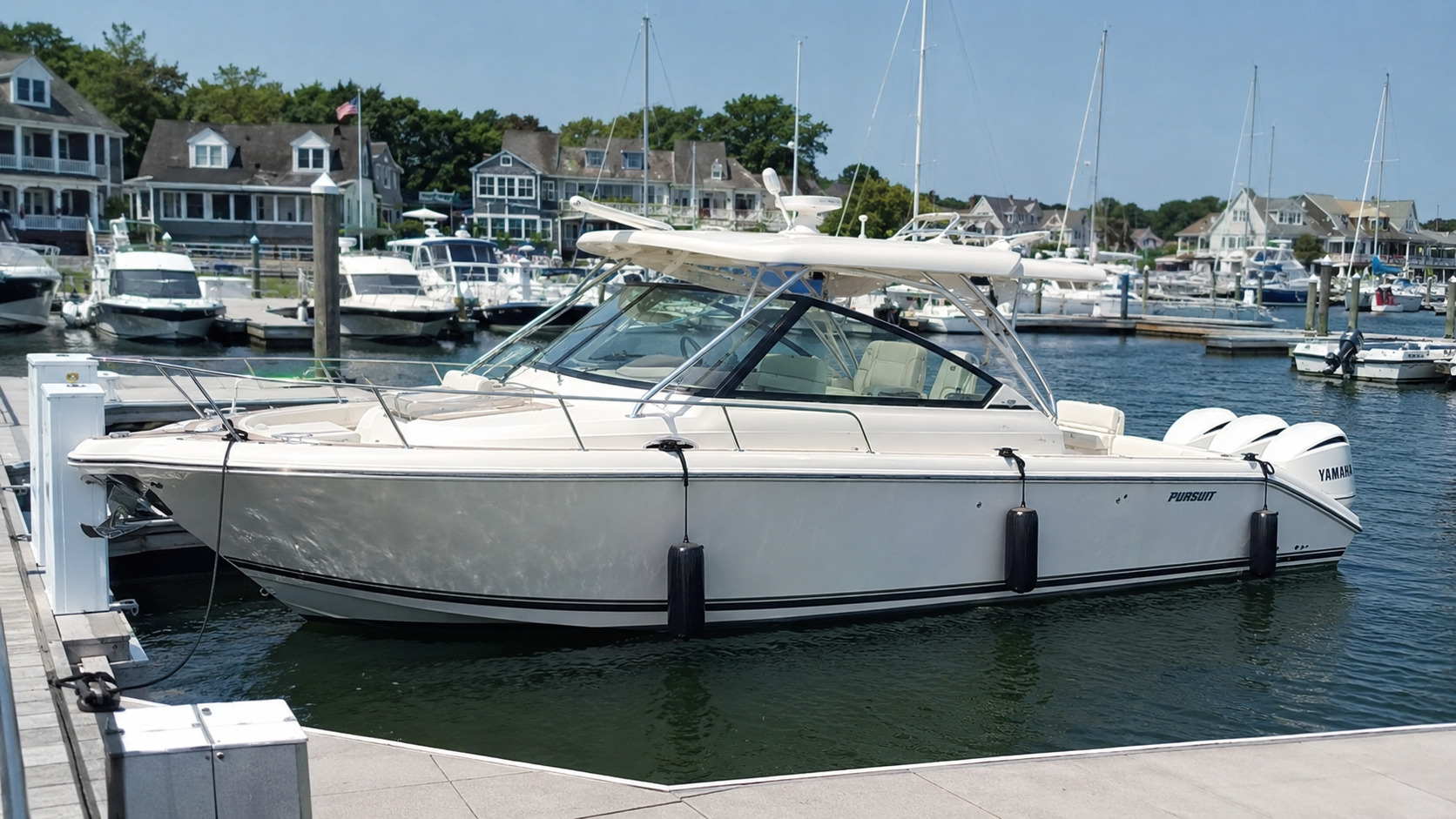
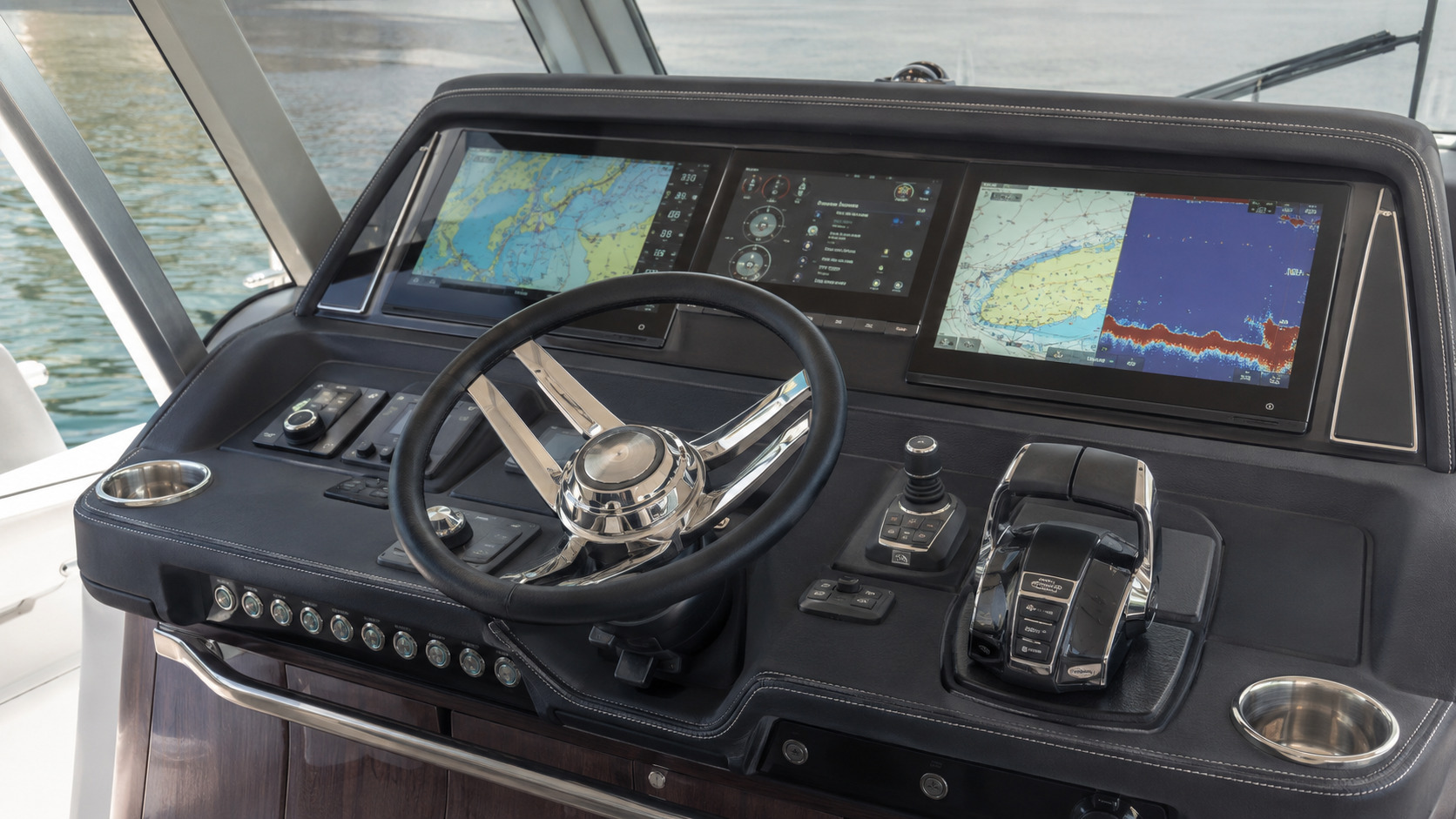
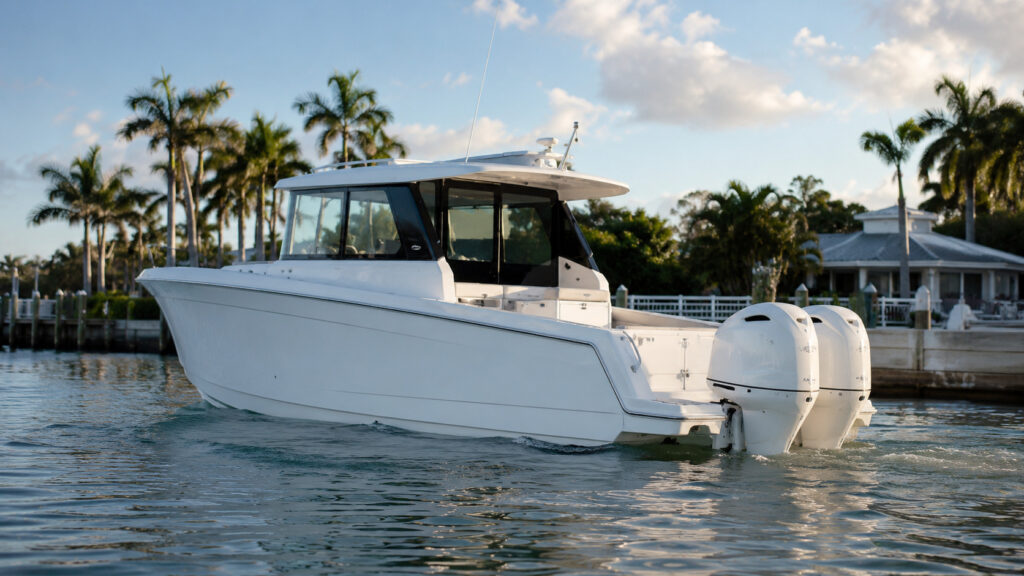
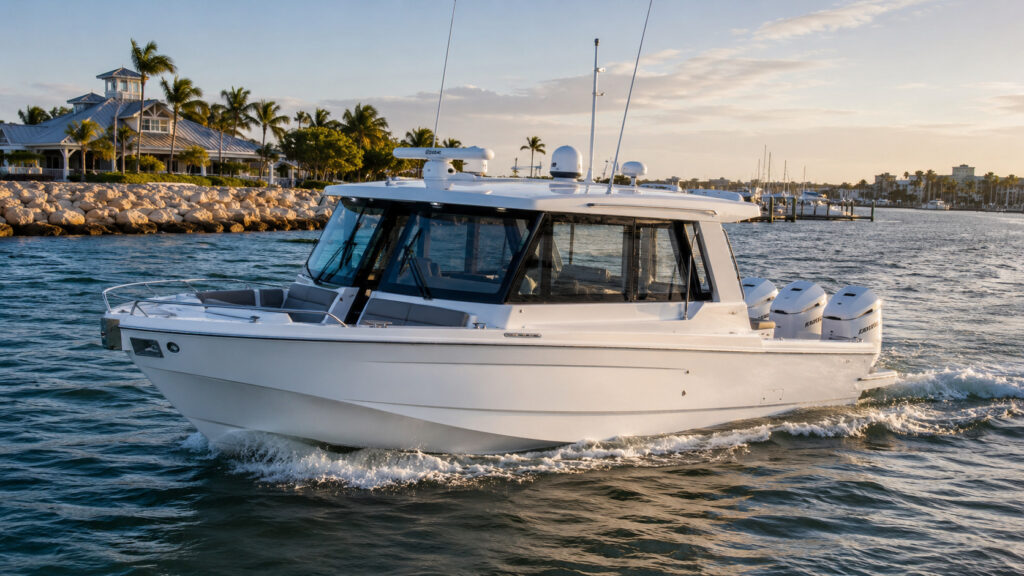
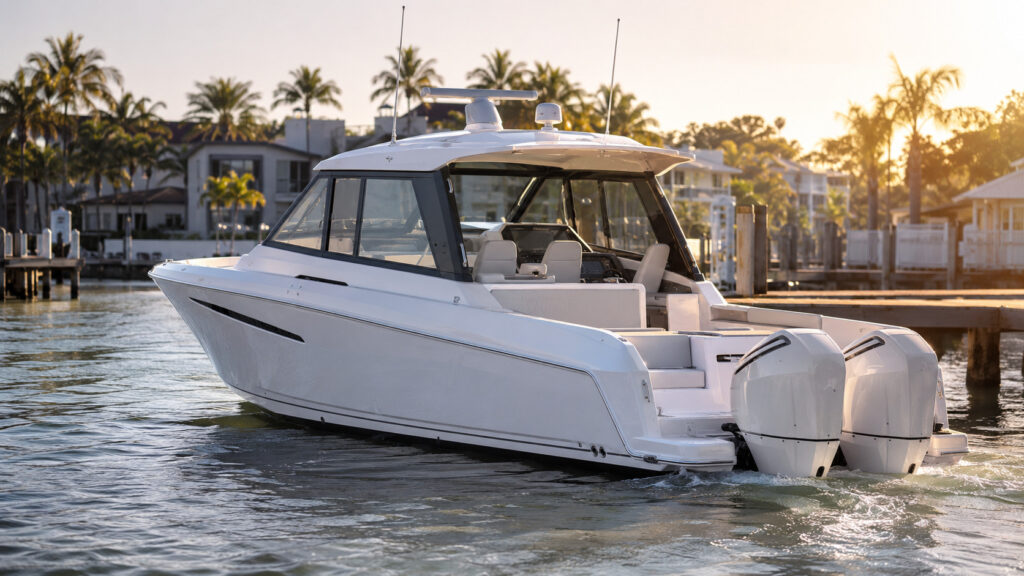
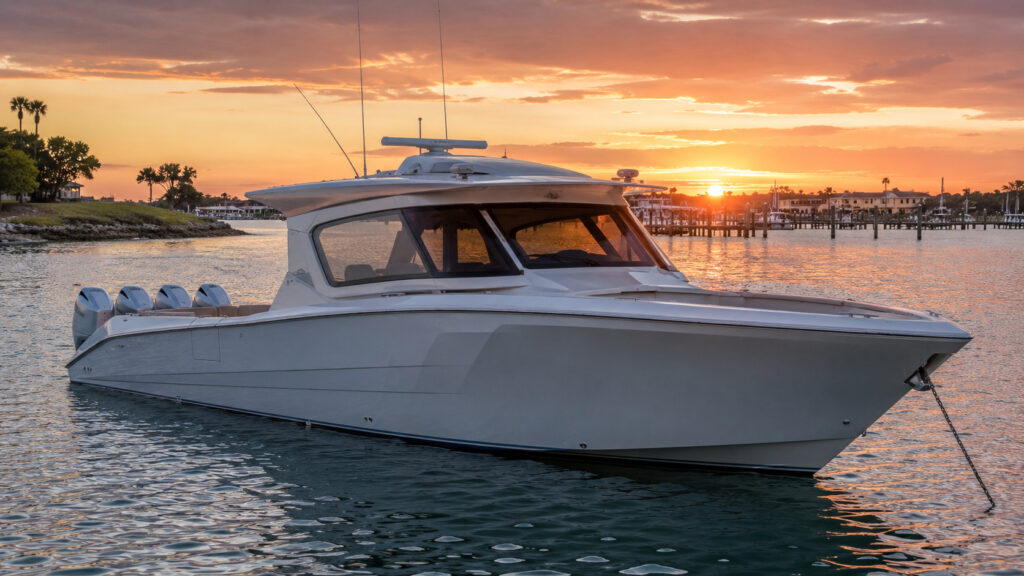
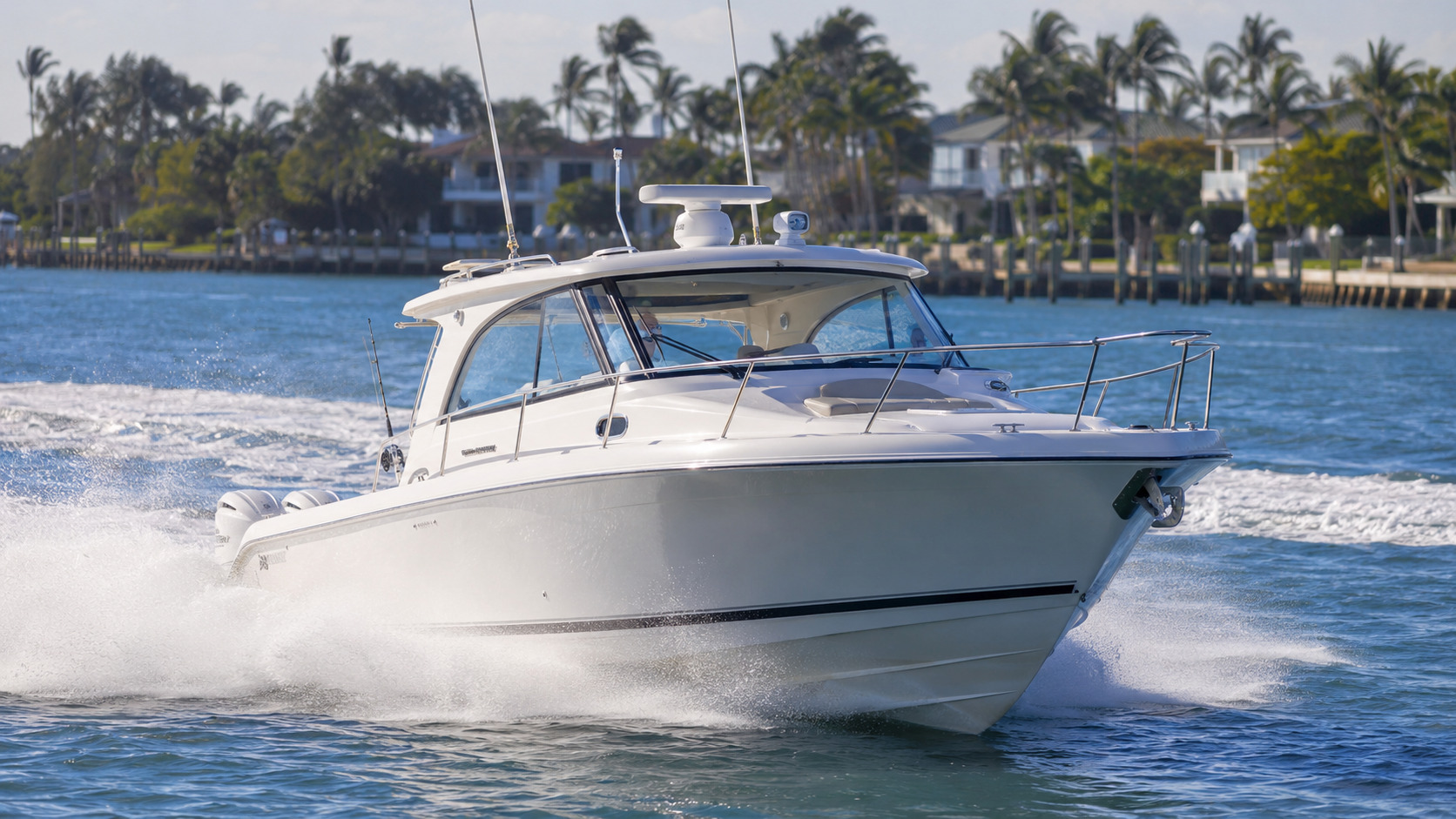
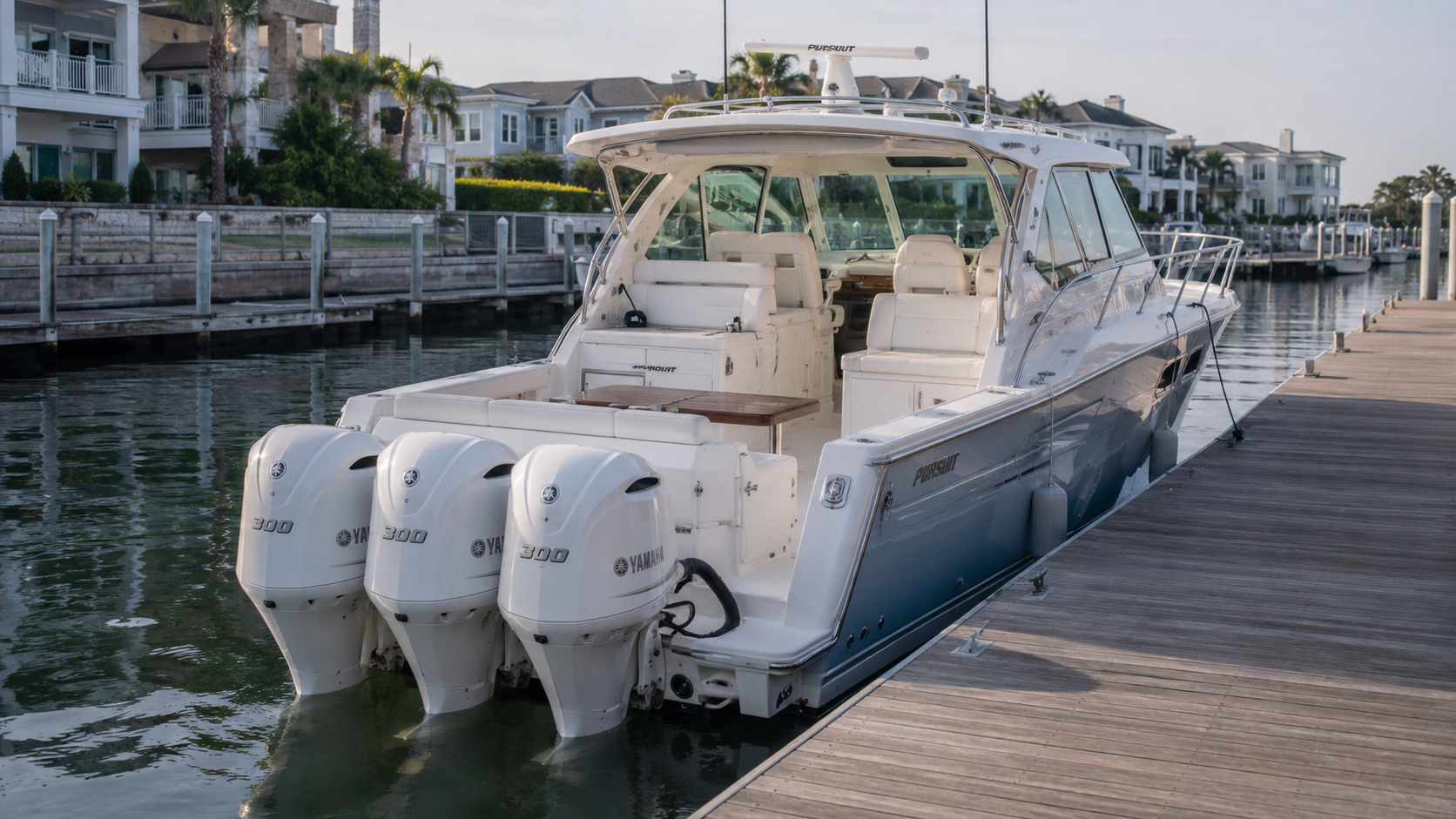
The Pursuit Offshore’s series is a cabin-cruiser line for buyers who still want a serious fishing cockpit. These boats are not center consoles with emergency bunks. They are built around protected helms, private heads, real galleys, overnight berths and outboard power, then finished with livewells, fish boxes and rod storage.
What the Pursuit Boats Offshore Series is built to do
Pursuit’s Offshore series is built for people who want to travel farther and stay aboard without giving up a working fishing cockpit. These are not center consoles with a small berth hidden inside the console. The cabin, galley, head, climate systems and bridge protection are central to the design.
The OS 325 is the manageable entry point: twin engines, four-person sleeping capacity and a real galley in a 34-foot-6-inch hull. The OS 355 adds beam, triple power and a much larger interior. The OS 405 crosses into small-yacht territory with 43 feet of length and standard gyro stabilization. The OS 445 moves farther again with a galley-up bridge deck and two dedicated staterooms.
That means the series should be chosen by trip length as much as boat length. A buyer who fishes offshore all day but sleeps at home has different needs from a couple who wants three nights aboard. More cabin, tankage and generator capacity solve real cruising problems, but they also create systems that must be maintained.
The financing conversation should come after that mission is clear, systems and multiple outboards beside the payment.
Every Offshore model combines a protected helm and cabin with an aft cockpit that is still intended to fish.
Livewells, fish boxes, rod storage and side boarding remain part of the package instead of being sacrificed for interior volume.
The OS 325 is the only twin-engine boat in this Offshore set. The OS 355, OS 405 and OS 445 move to triples, which improves thrust and redundancy at their size but raises routine service cost. On the 405 and 445, three F450 XTO outboards make propulsion a major line item in the annual budget.
Interior separation becomes more meaningful as the boats grow. The 325 and 355 use convertible forward sleeping areas with additional mid-berths. The 405 adds a more yacht-like island forward berth and separate mid-cabin. The 445 uses a dedicated primary stateroom plus a separate guest cabin and moves the galley to the bridge deck.
Tankage grows with the cruising mission. The OS 325 carries 300 gallons of fuel, the 355 carries 388, the 405 carries 482 and the 445 carries 600. Freshwater capacity also rises. Those numbers are useful for range and comfort, but they are also a reminder that a fully provisioned Offshore model can be thousands of pounds heavier than its dry specification.
How to choose within the Pursuit Boats Offshore Series
The OS 325 is the rational starting point when the owner truly needs a cabin but still wants twin-engine simplicity.
It has enough sleeping capacity for a family weekend and enough cockpit equipment to fish seriously, yet it does not force the service and fuel scale of the triple-engine boats.
Move to the OS 355 when the cabin is being used regularly rather than occasionally. The extra beam, mid-berth, larger galley, bigger fish boxes and more fuel all become meaningful on longer trips. If those features stay closed most weekends, the 325 remains easier to own.
The OS 405 should be evaluated as a small yacht. Standard stabilization, triple 450s, a large bridge deck, island berth and separate guest space create comfort that can justify long offshore passages. They also require an owner who is comfortable maintaining generator, gyro, climate, refrigeration and more complex electrical systems.
The OS 445 is for buyers whose cruising plan needs two true sleeping areas and more separation between cooking, socializing and resting. Its 13-foot-10-inch beam and 30,000-plus-pound dry weight are advantages once offshore and constraints everywhere else. Slip, haul-out and service access should be confirmed before purchase.
Owning a Pursuit Boats Offshore Series beyond the loan payment
The lightest boat in this set is the OS 325 at about 13,740 lb dry. The heaviest is the OS 445 at about 30,718 lb.
That spread is large enough to change service logistics, dockage, fuel use and the kind of waterfront infrastructure an owner needs.
Offshore ownership starts at the engines but does not stop there. Generator service, air conditioning, refrigeration, freshwater pumps, heads, battery chargers, windlasses and stabilization systems all need attention. A boat with excellent engines and neglected hotel systems can still produce an expensive first season.
Cabin condition is a strong indicator of how the boat has been kept. Odor, condensation staining, water marks around windows, soft headliners and corroded appliance hardware can reveal problems that a bright cockpit hides. Buyers should inspect below deck before the sea trial and again after systems have been running.
Dockage is part of the model decision. The 325 fits many slips that will not comfortably handle a 445. Beam, platform length, outboards and boarding space matter. Owners moving up from a smaller boat should confirm marina limits and haul-out capability before assuming their current arrangements still work.
Use financing as one line in the ownership budget.
Annual engine service, generator service, bottom maintenance and a reserve for climate, refrigeration and electronics.
The correct Offshore model leaves room to keep every system working.