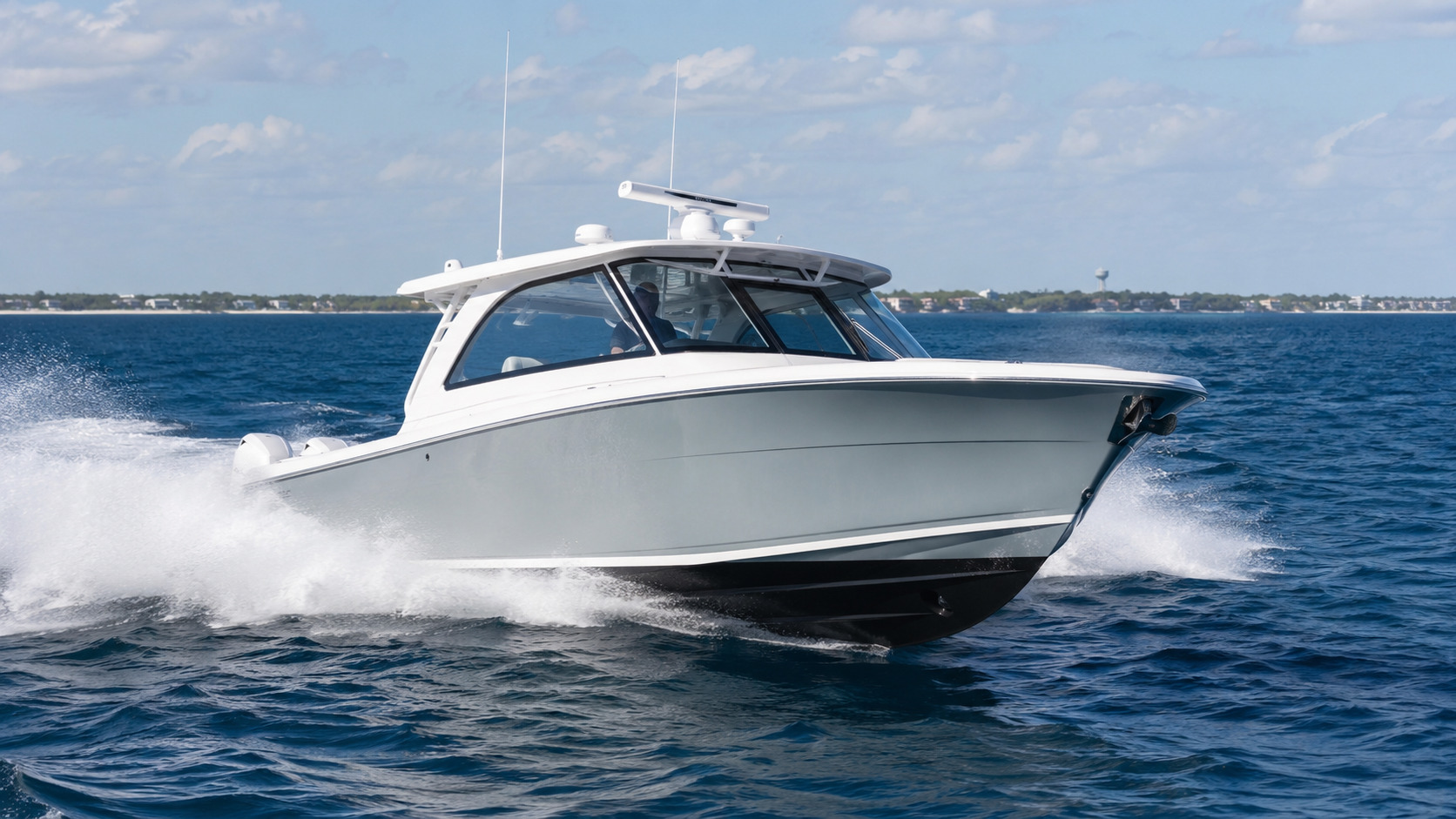
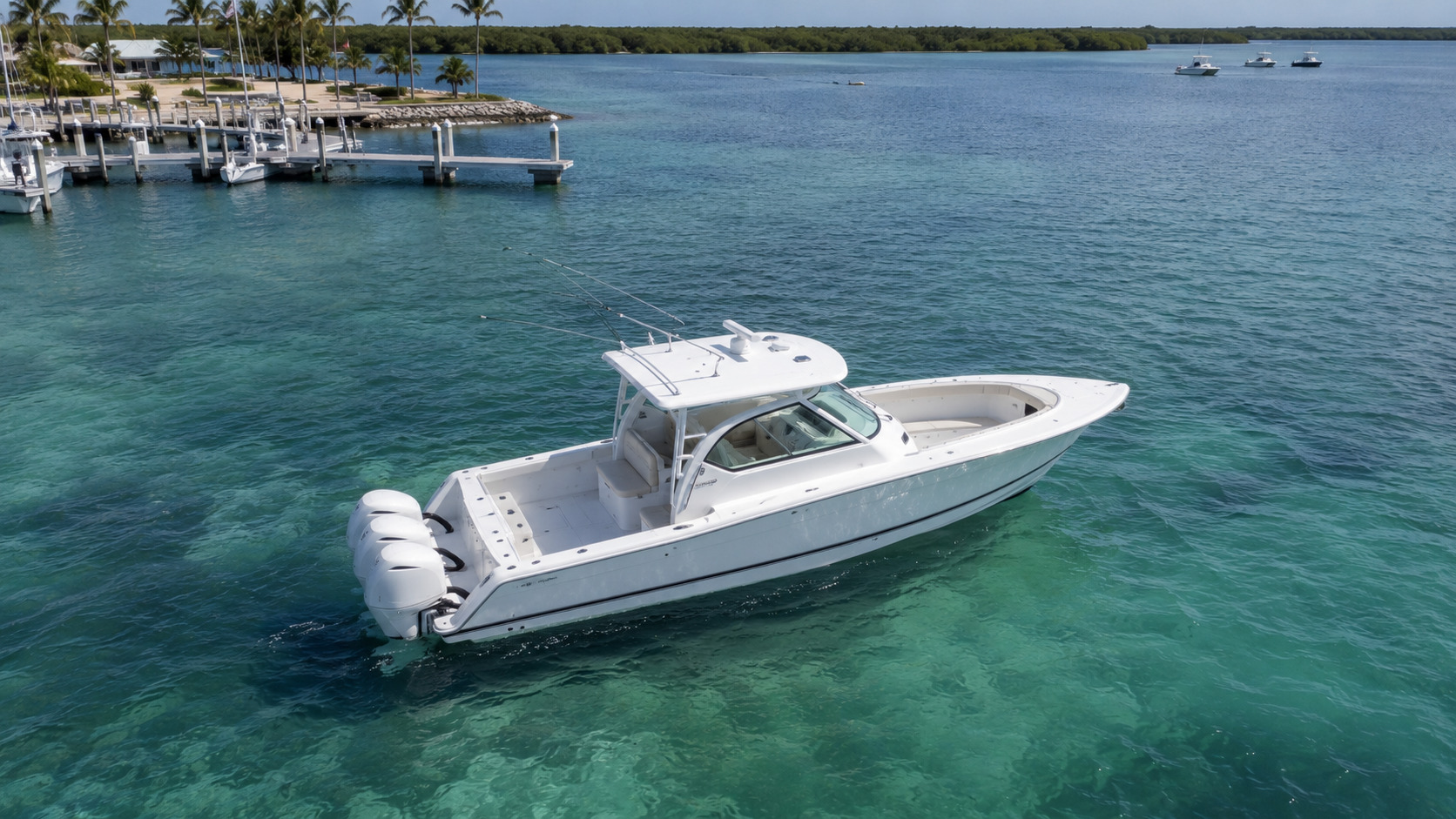
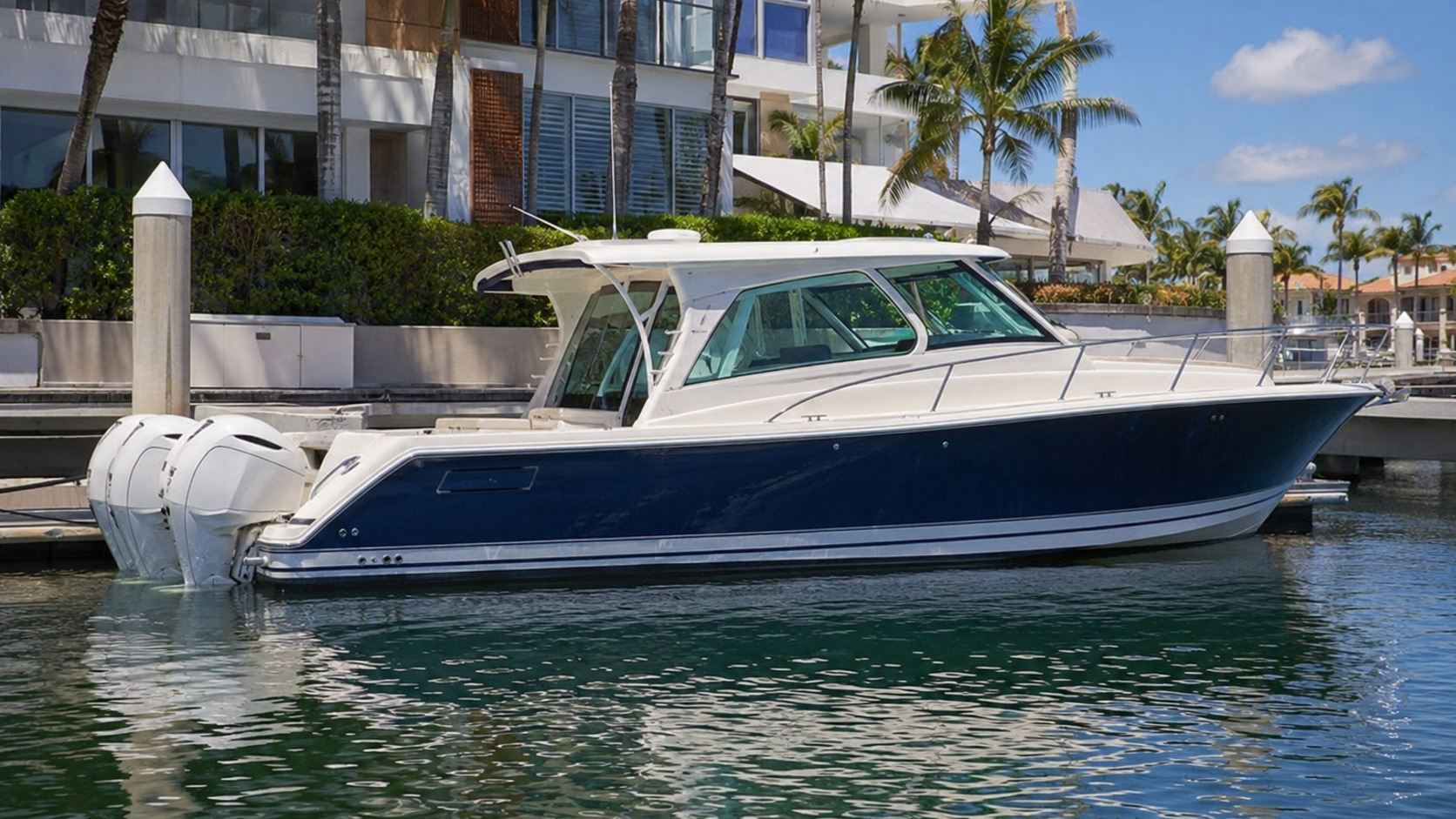
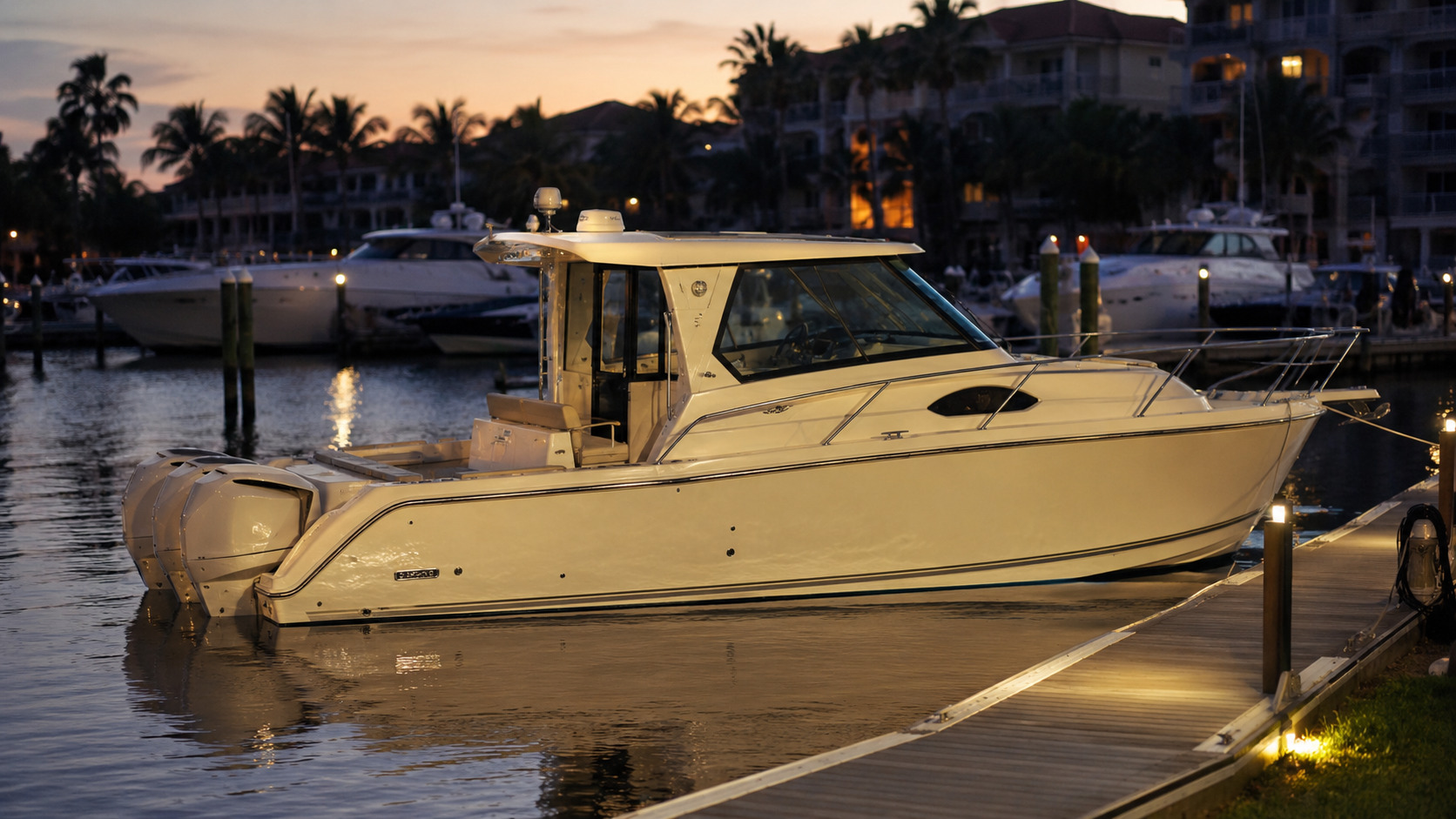
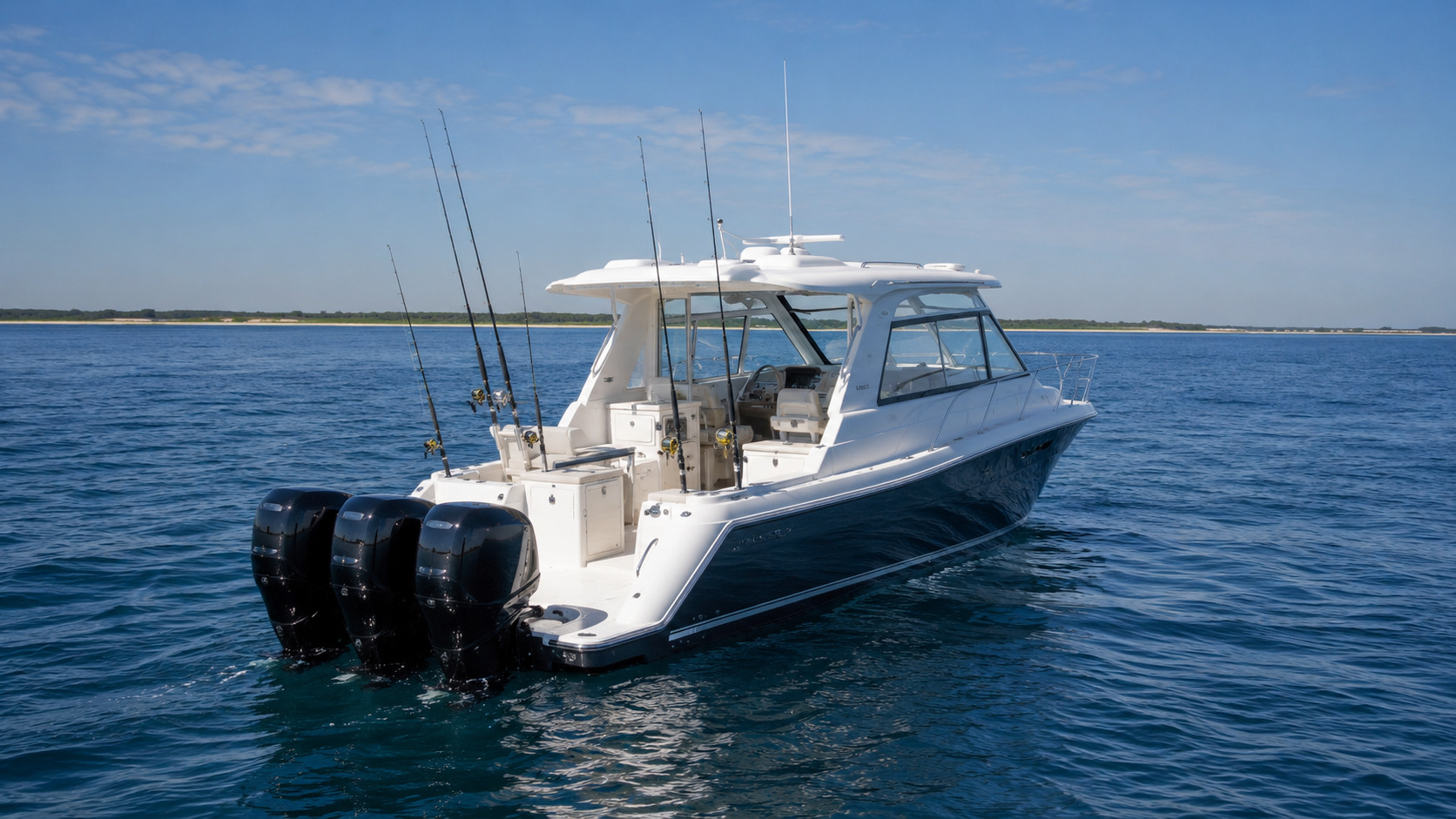
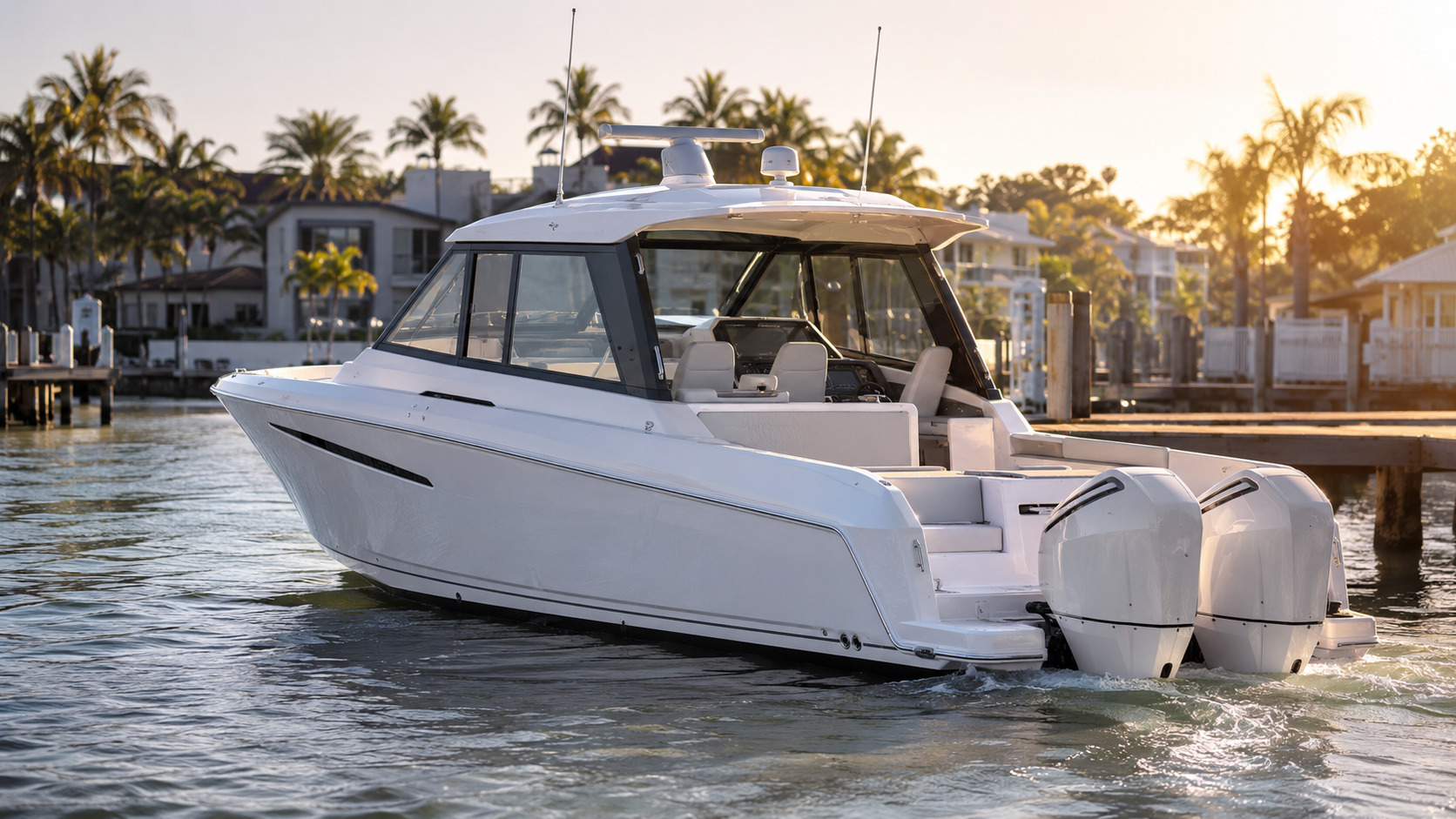
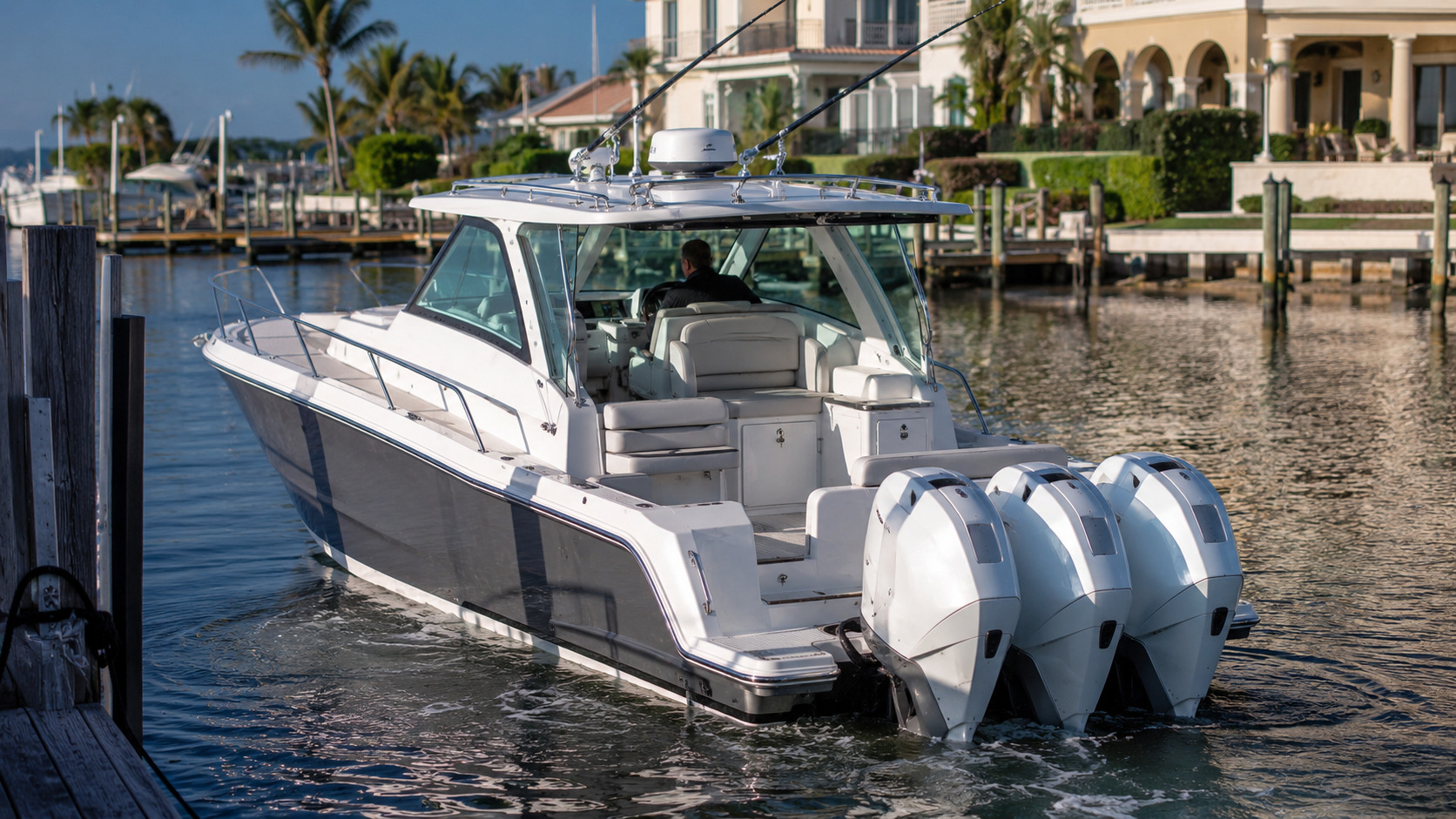
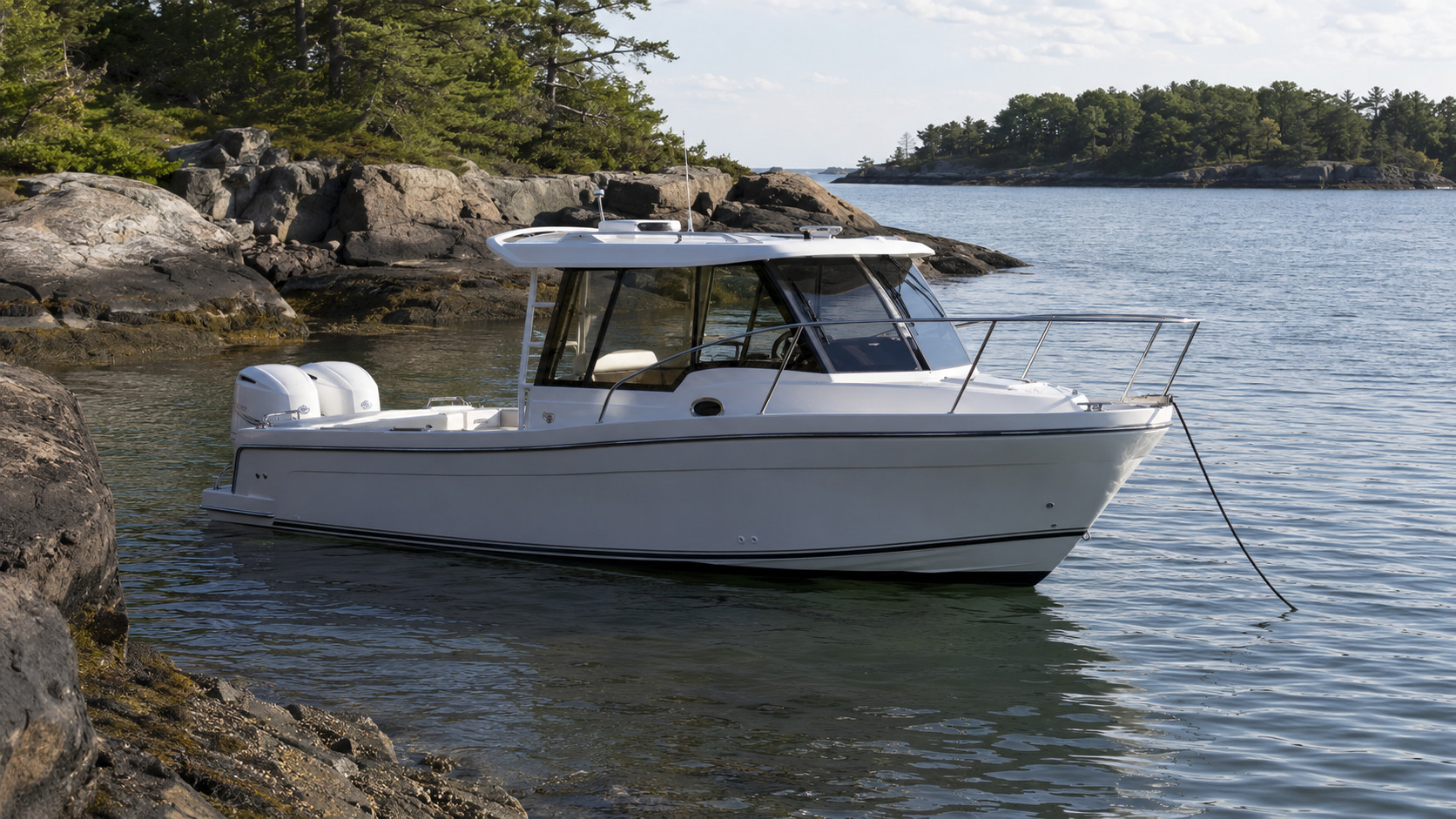
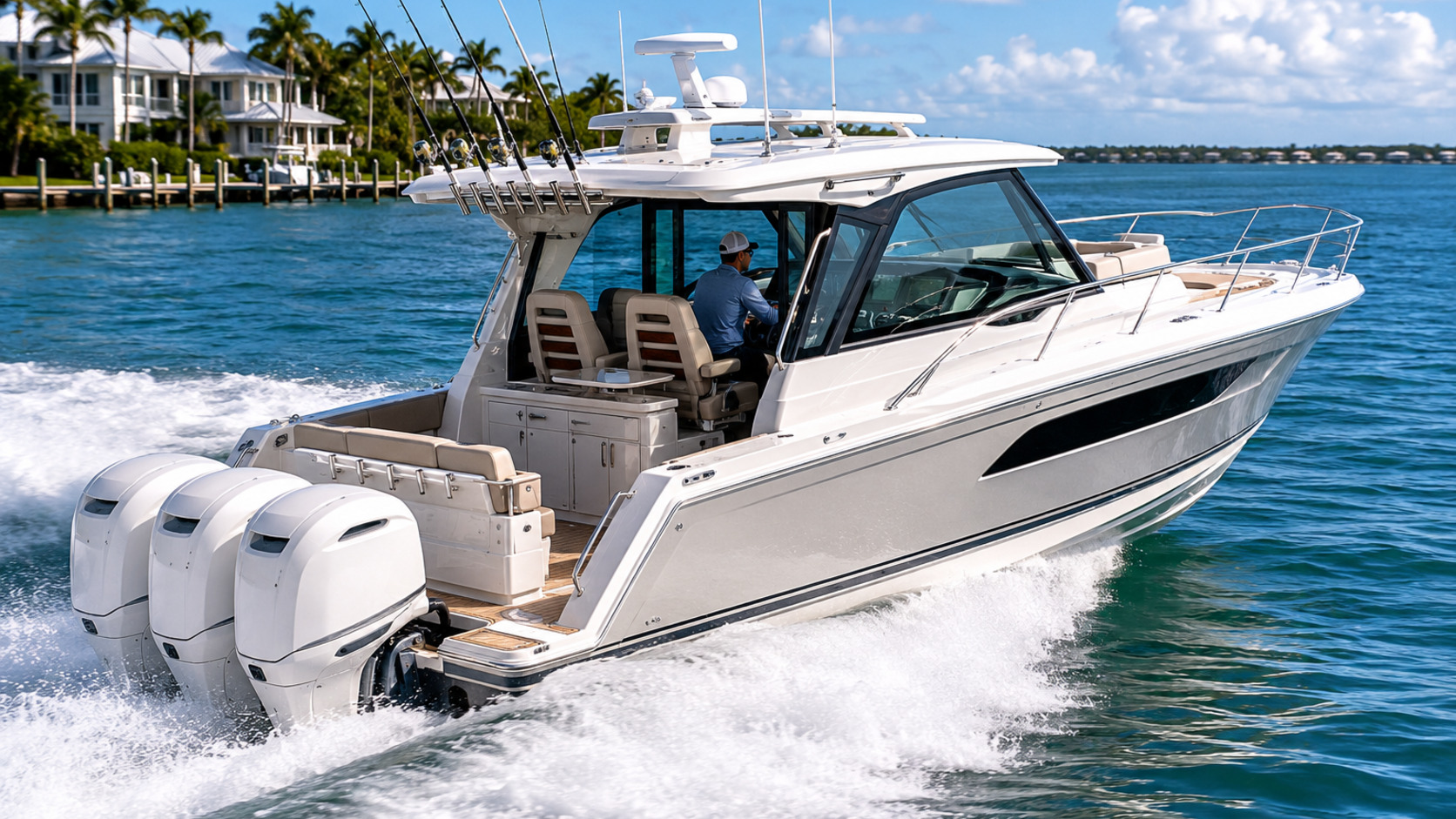
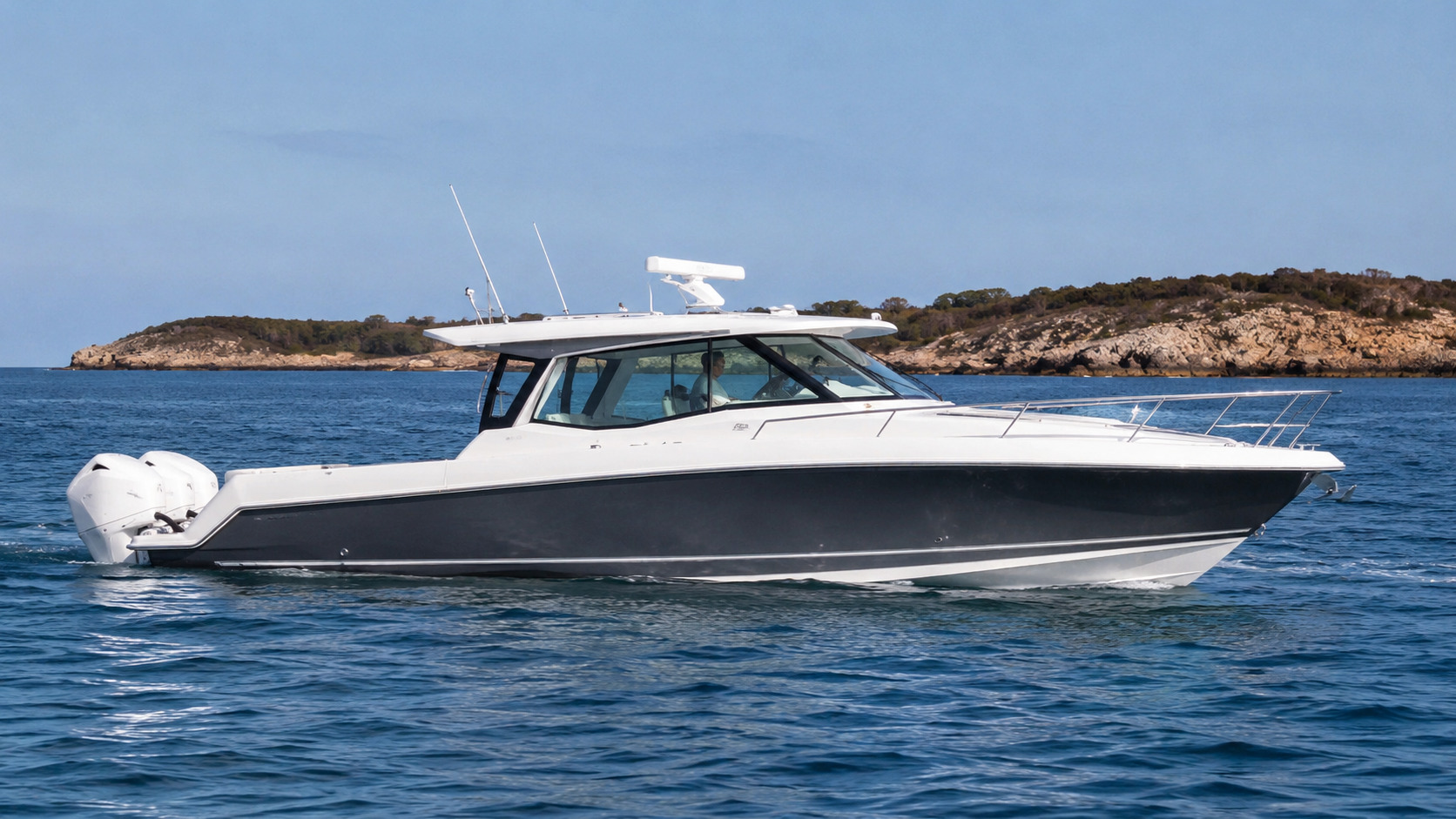
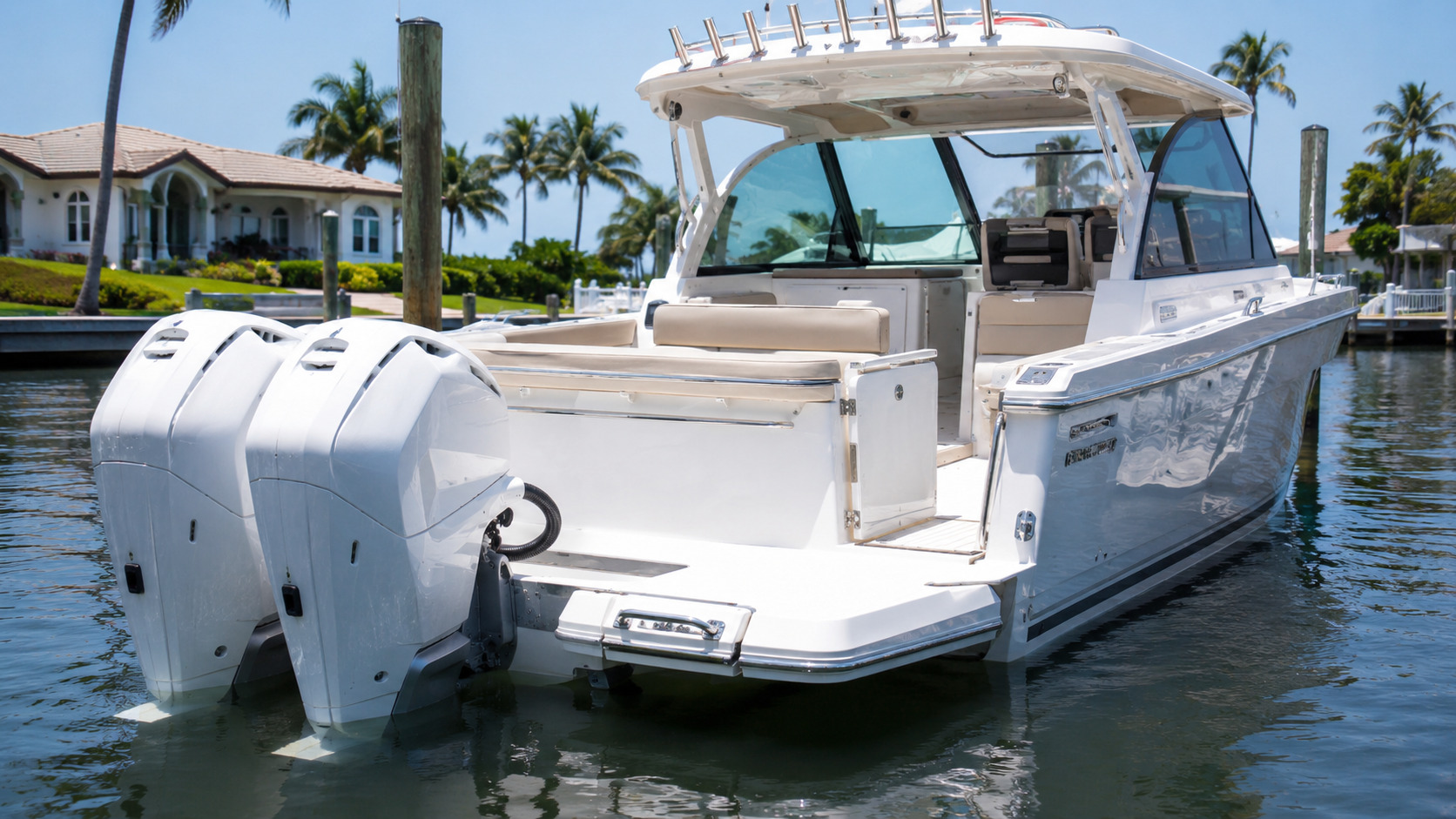
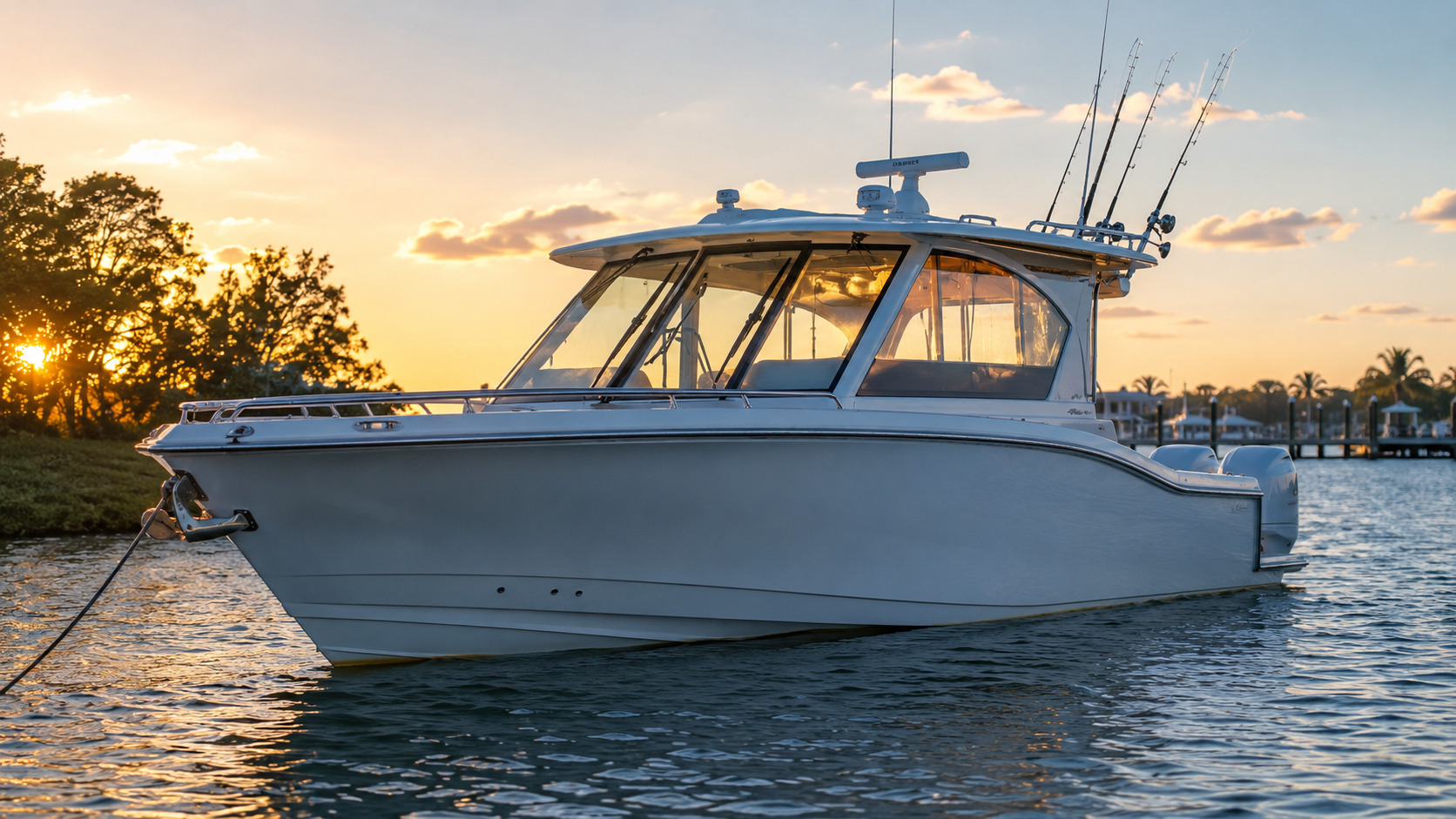
The Pursuit OS 355 is a 38-foot offshore express that moves beyond the OS 325 with triple power, a 12-foot beam, full galley and much more substantial bridge and cabin space.
The easiest way to understand the Pursuit OS 355 is to ask what it does better than a nearby Pursuit. Here, the answer is concrete: It is large enough to feel like a cruising boat below deck while keeping a fishable cockpit, 28-gallon livewell and twin 45-gallon fish boxes above. That makes it a strong match for owners who expect real offshore miles and regular overnight trips but still want an outboard boat that can fish hard, not for every buyer who happens to like the brand. The boat is 37′ 11″ long, 12′ 0″ wide and roughly 17,470 lb before fuel, water and gear. Its tank holds 388 gal, and the published power ceiling is 1,050 hp. Those specifications put it at one of the middle steps in this 4-model group, which affects slip size, service logistics and the amount of boat the owner has to manage around the dock. The OS 355 gains meaningful range, cabin comfort and weather protection, but triple engines, generator systems and 17,470 pounds of dry weight push service, fuel and marina requirements well beyond the 325. The OS 325 changes the equation by offering lower operating scale and twin-engine simplicity. The OS 405 makes more sense when the buyer wants a significantly larger boat with more interior separation and standard stabilization. The DC 365 is the more relevant alternative when the buyer wants more open-bow day-boating flexibility with a smaller cabin emphasis.
The OS 355 is where Pursuit’s Offshore range becomes a larger cruising platform rather than a compact weekender. The 12-foot beam, triple F350s, queen conversion, mid-berth and full galley give two couples or a family far more room to live aboard. That extra comfort comes with a third engine and more systems, so the model makes the most sense when overnight use is regular rather than aspirational.
A 20° transom deadrise, 12′ 0″ beam and 3′ 3″ engines-down draft define the basic running geometry of the OS 355. Pursuit’s approximate dry figure is 17,470 lb. Once the boat is carrying 388 gal of fuel, people, water and equipment, the real displacement can be much higher. If lower operating scale and twin-engine simplicity is consistently more important than what the OS 355 delivers, the OS 325 is the more honest next step.
The 355 carries 17,470 pounds dry before 388 gallons of fuel, water and cruising gear are added. That is enough mass to make the boat feel settled offshore and enough mass to make marina and haul-out planning important. Run the boat with tabs at several settings and feel how the 12-foot beam behaves in a quartering sea. The bigger hull should make the crew more comfortable, not simply make the slip more expensive.
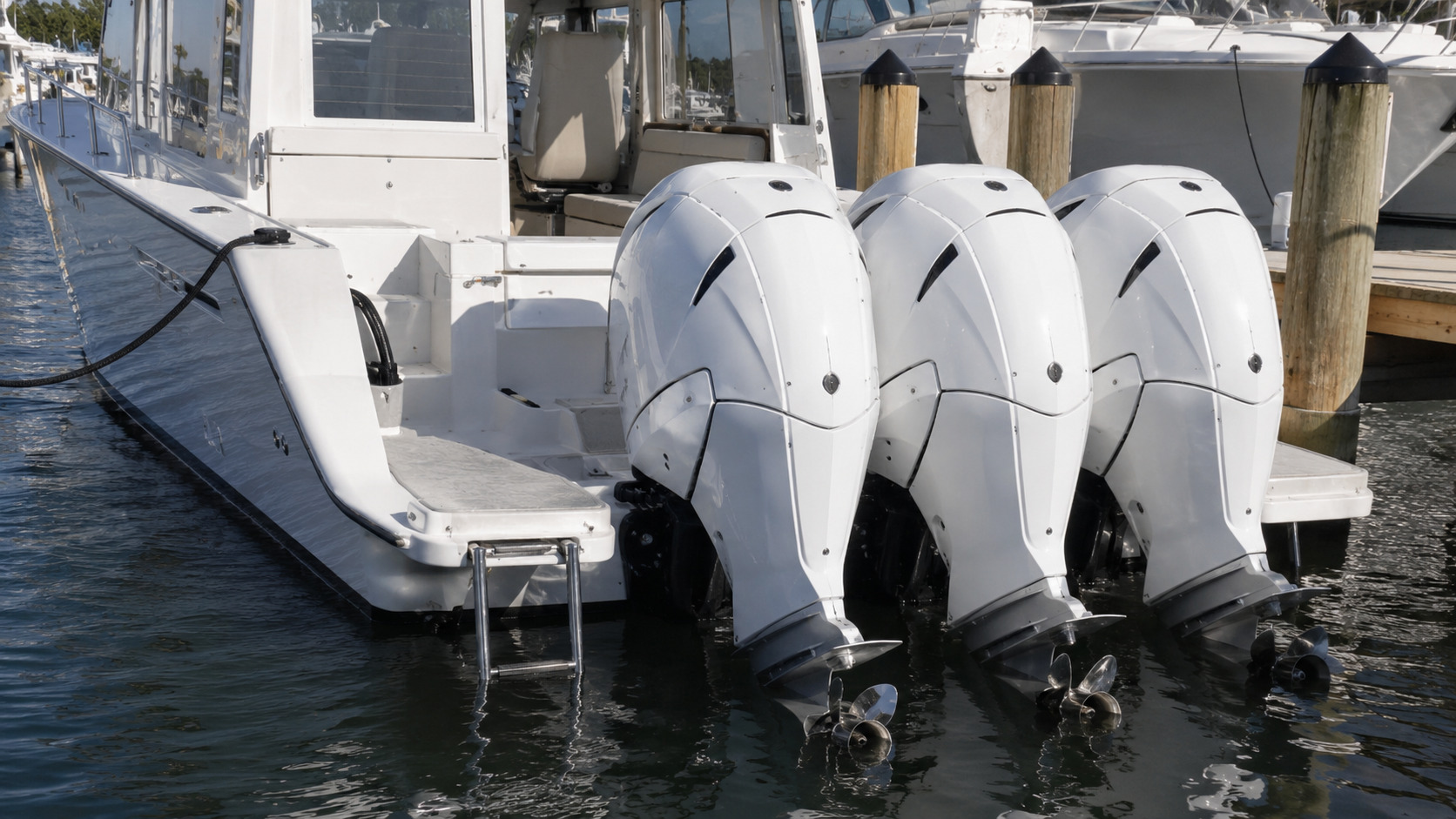
The OS 355 is rated to 1,050 hp and is represented here with triple Yamaha F350. Power selection should be judged against dry weight of about 17,470 lb, a possible 388 gal fuel load and the crew or fishing gear the owner normally carries.
Triple F350s give the OS 355 the thrust expected at this size while avoiding the larger 450 XTO package used on the 405. Service records should be complete across all three engines. During the sea trial, watch whether the center and outside engines carry similar rpm and fuel flow at cruise. A triple setup can tolerate an engine failure offshore, but that redundancy is not a substitute for maintaining all three equally.
Fuel capacity, cruise planning and operating range
The OS 355 carries 388 gal of fuel. Ownership math changes once the OS 355 is loaded. The dry figure is about 17,470 lb, and a full 388 gal fuel load adds substantial mass before freshwater, people and gear. That wet condition is the one a lift, haul-out yard or transport plan needs to support. Buyers moving up from a smaller boat should confirm those limits before assuming their current infrastructure will carry the OS 355.
A useful OS 355 fuel plan also includes the hotel load. With 388 gal in the main tank and cruising systems running, generator time can be part of a multi-day trip even when the outboards are off. Record engine consumption at cruise, then keep generator use and reserve fuel separate so the owner knows what portion of the tank is genuinely available for the return leg. On a OS 355 trip measured in offshore hours rather than local miles, a best-case range estimate is less useful than a conservative return reserve.
An OS 355 should feel predictable before it feels fast. The 20° deadrise figure helps explain the running surface, but it is only one piece. Use the OS 325 as a reality check if lower operating scale and twin-engine simplicity sounds closer to the owner’s priorities.
The OS 355 should be tested as a cruising boat carrying real offshore weight. Run with enough fuel and people to represent a trip, let the cabin systems operate, and settle the 20° hull at a comfortable long-range cruise rather than chasing maximum speed. Note bridge noise, windshield visibility and how easily the driver holds course in quartering chop. The OS 325 is the useful check if the OS 355’s added cruising capability does not change the trip enough to justify its ownership scale.
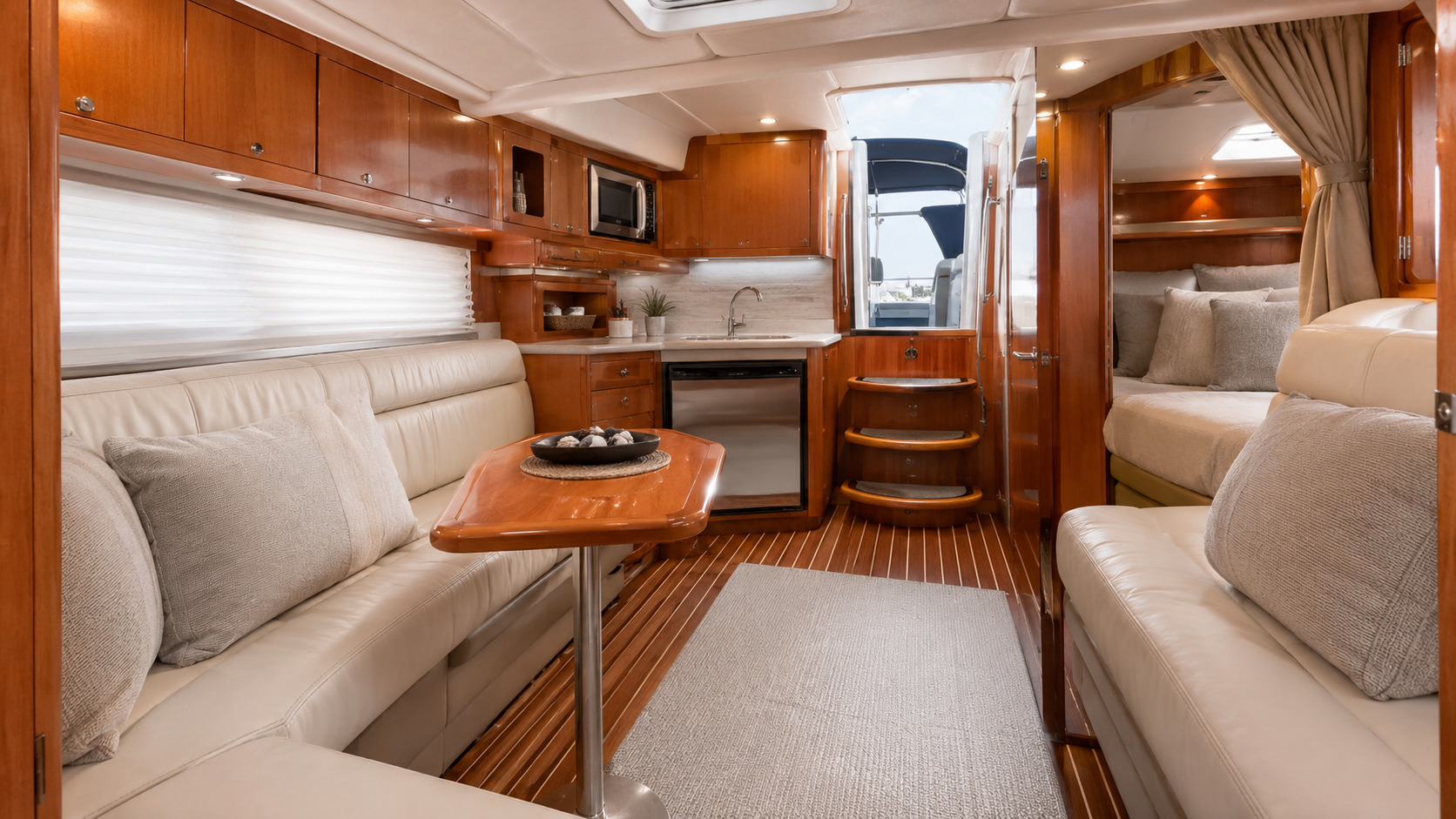
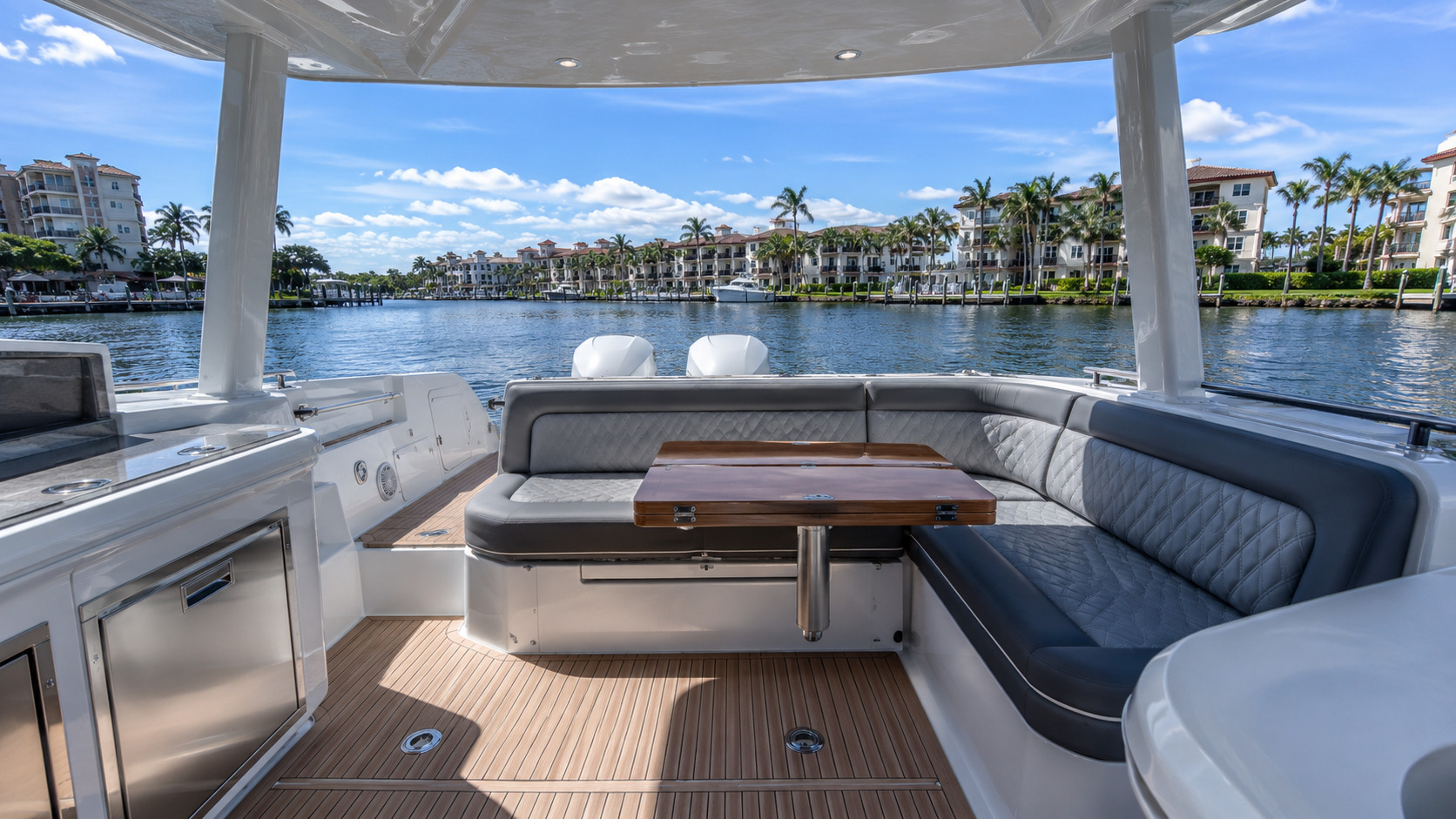
The cockpit on an OS 355 has to perform two jobs without feeling compromised: it must be comfortable socially and remain useful when the fishing gear comes out. Start with Convertible queen-size forward berth, then use Full mid-berth and Full galley with refrigerator and cooktop.
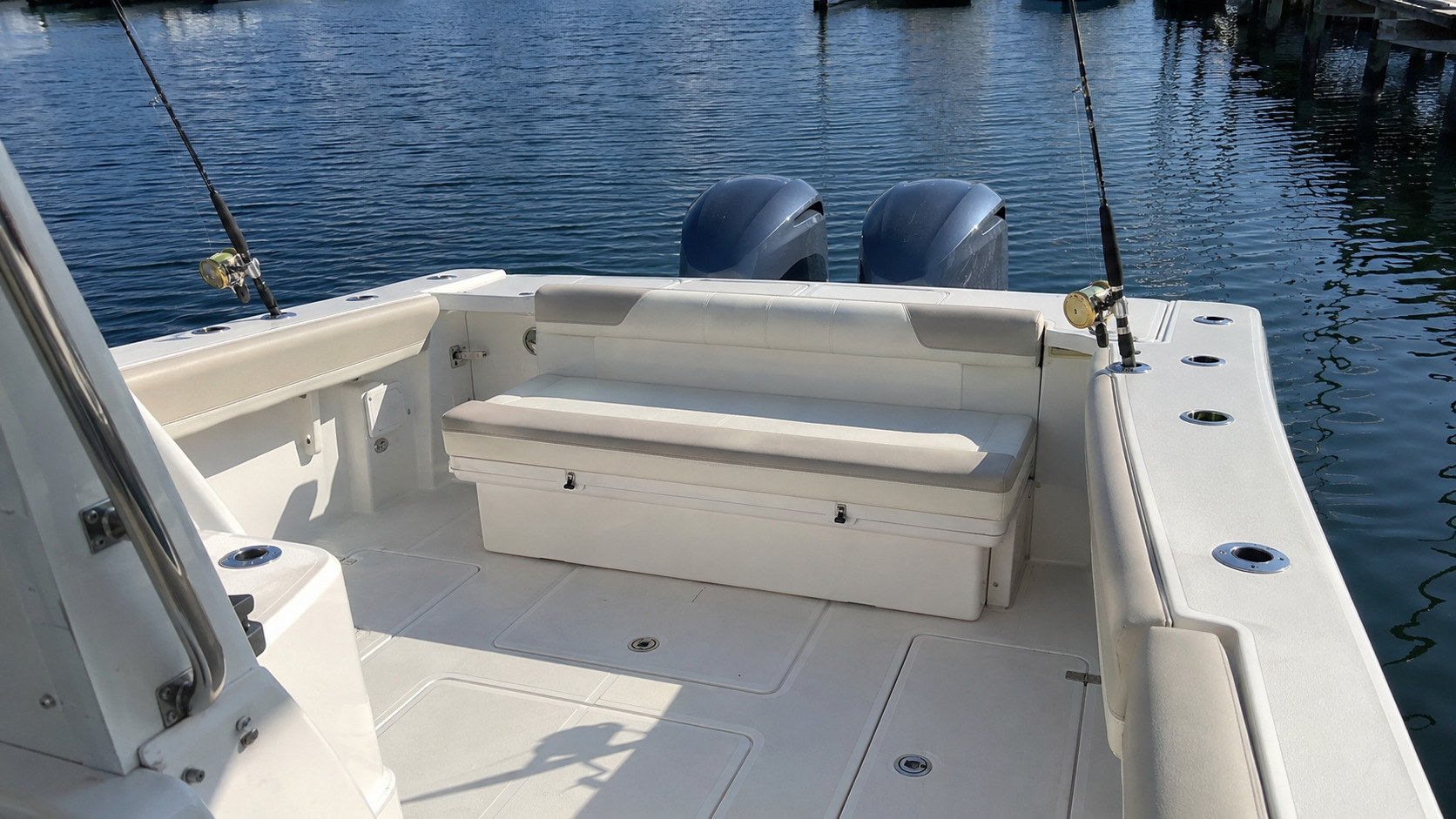
The bridge lounge and cockpit entertainment center are important because a cruising crew spends a lot of time above deck. Sit in the forward-facing lounge underway, then use the grill and refrigerator at anchor. The aft cockpit should still leave enough room to open the 28-gallon livewell and twin 45-gallon fish boxes. The 355 works best when neither cruising nor fishing feels like an afterthought.
28-gallon recirculating livewell – The fishing layout remains serious even with a full cruising interior.
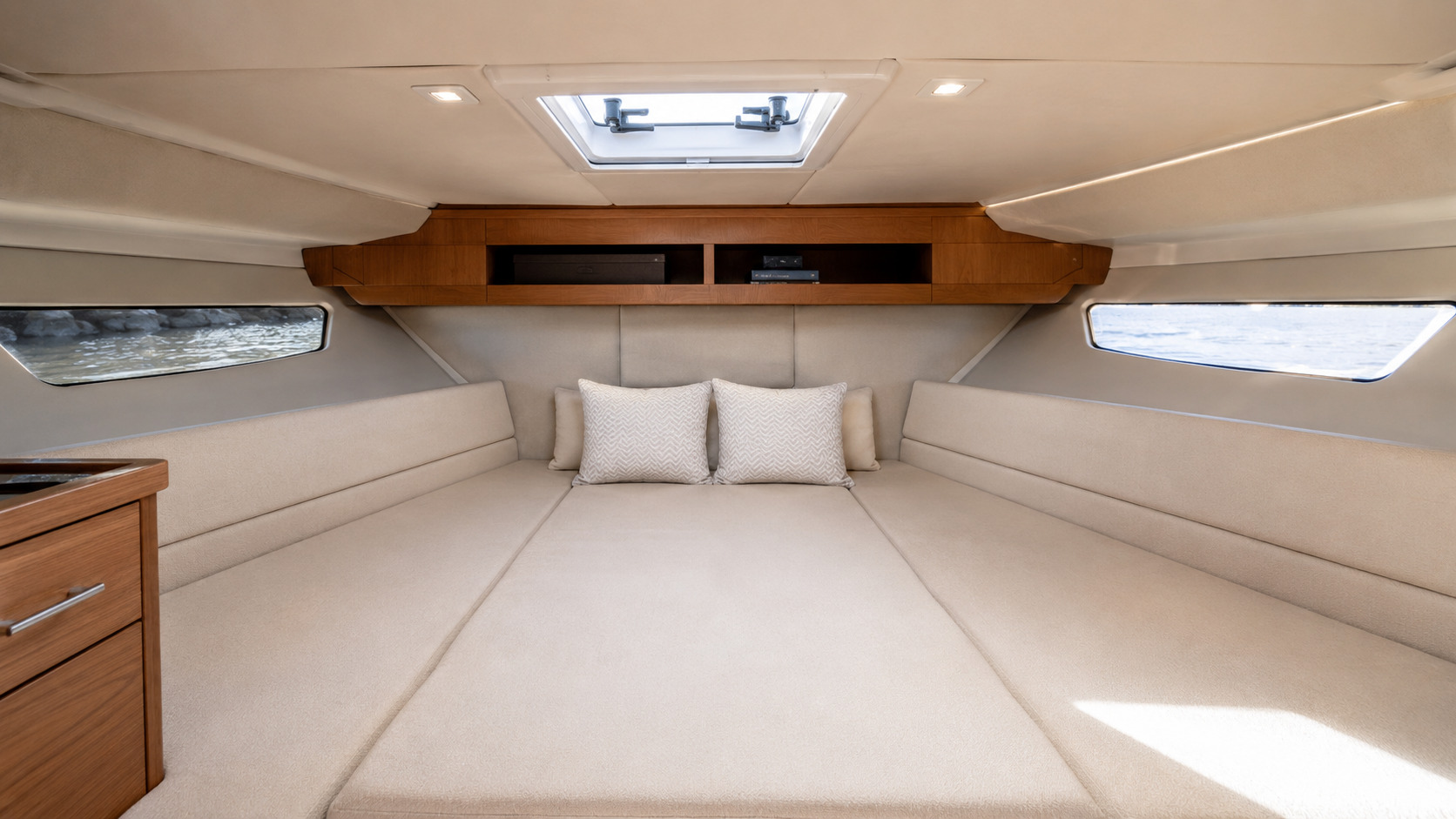
Convertible queen-size forward berth
The main cabin changes from seating to a full sleeping position electrically, preserving social use during the day.
Full mid-berth
A separate mid-cabin sleeping area lets two couples or a family use the boat without sharing one berth.
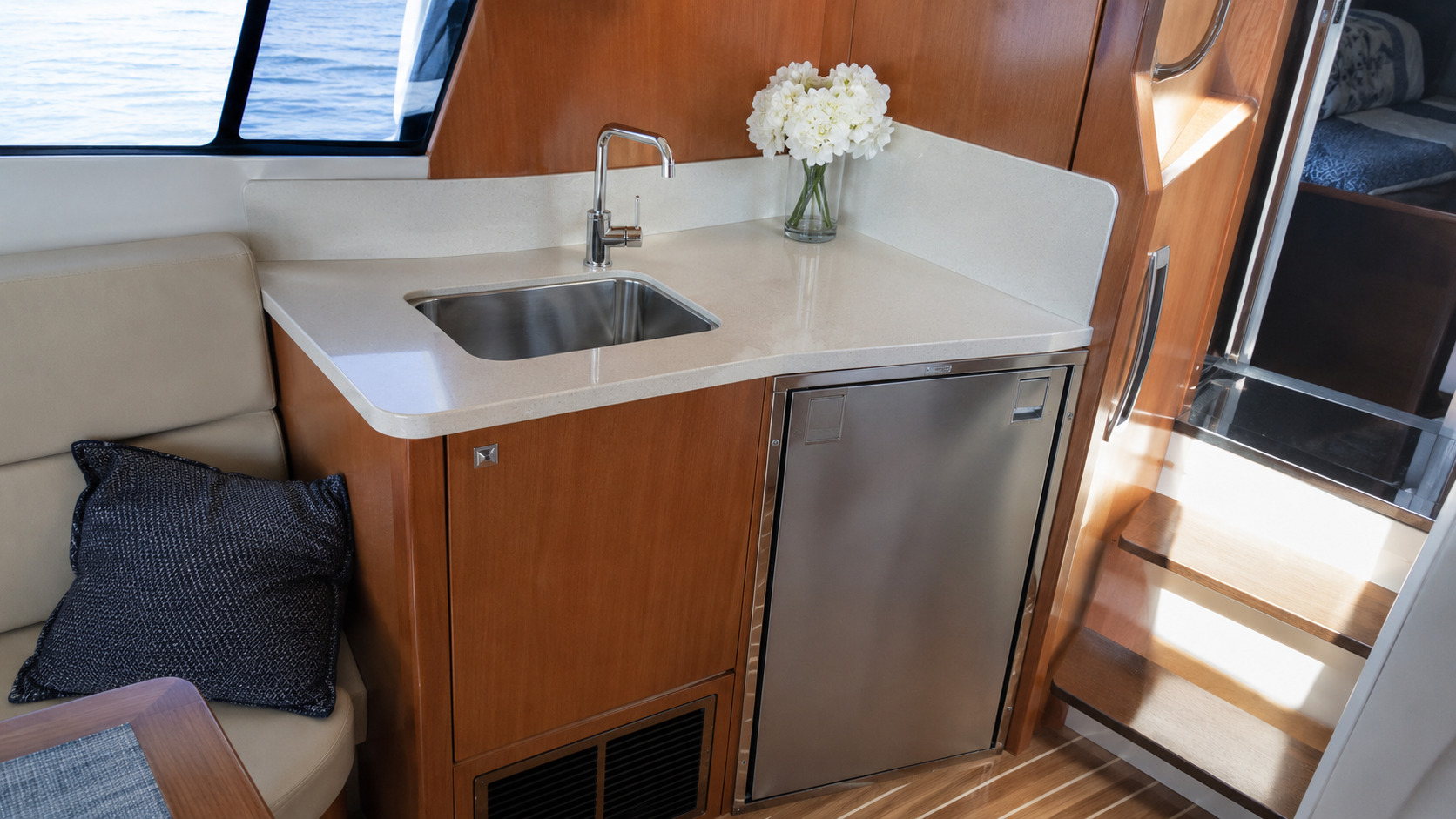
Full galley with refrigerator and cooktop
The 355 supports actual meal preparation instead of relying on cockpit snacks.
Twin 45-gallon fish boxes
Large pumped fish boxes let the cockpit stay functional after a successful offshore day.
Triple F350 outboards
Triple power gives the hull the thrust expected for offshore running, with corresponding maintenance cost.
Bow thruster
Low-speed assistance becomes more valuable at this beam and windage.
Electronics, pumps and onboard systems
The OS 355 systems check should focus on the equipment that makes this particular model valuable: Convertible queen-size forward berth, 28-gallon recirculating livewell, Triple F350 outboards and 16,000-BTU cabin climate system. Begin with the electrical foundation.
The full galley, cabin climate system, generator, refrigerators and sanitation systems turn the 355 into a small cruising household. Test them together. Heat the cooktop or microwave while refrigeration and air conditioning are running, then watch generator and battery behavior. On a pre-owned boat, ask which cabin systems have been serviced recently. Owners often document engines carefully while forgetting pumps and appliances until they fail.
Overnight capability on the OS 355 is described as sleeping capacity for four with convertible queen-size forward berth and mid-berth. Freshwater capacity is 50 gal, with 22 gal for waste.
The electrically convertible forward queen and separate mid-berth create more useful separation than the OS 325. That makes the 355 a better fit for regular family weekends or two adults who want a guest area. Test the mid-berth for ventilation and access, and look closely for condensation staining. A dark, rarely used berth can hide moisture problems even when the main cabin presents beautifully.
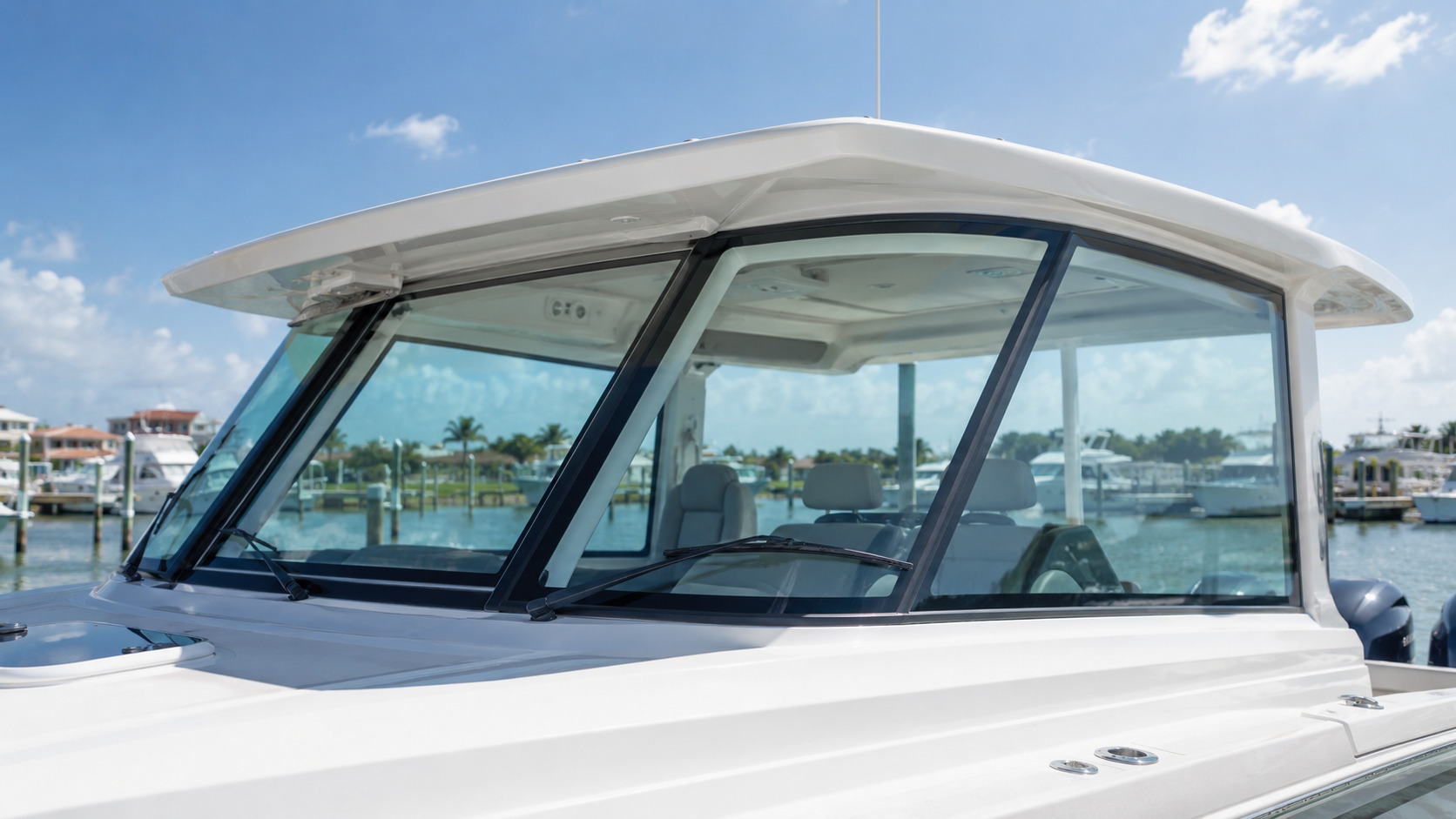
pursuit boats offshore os 355 hardtop glass detail 18
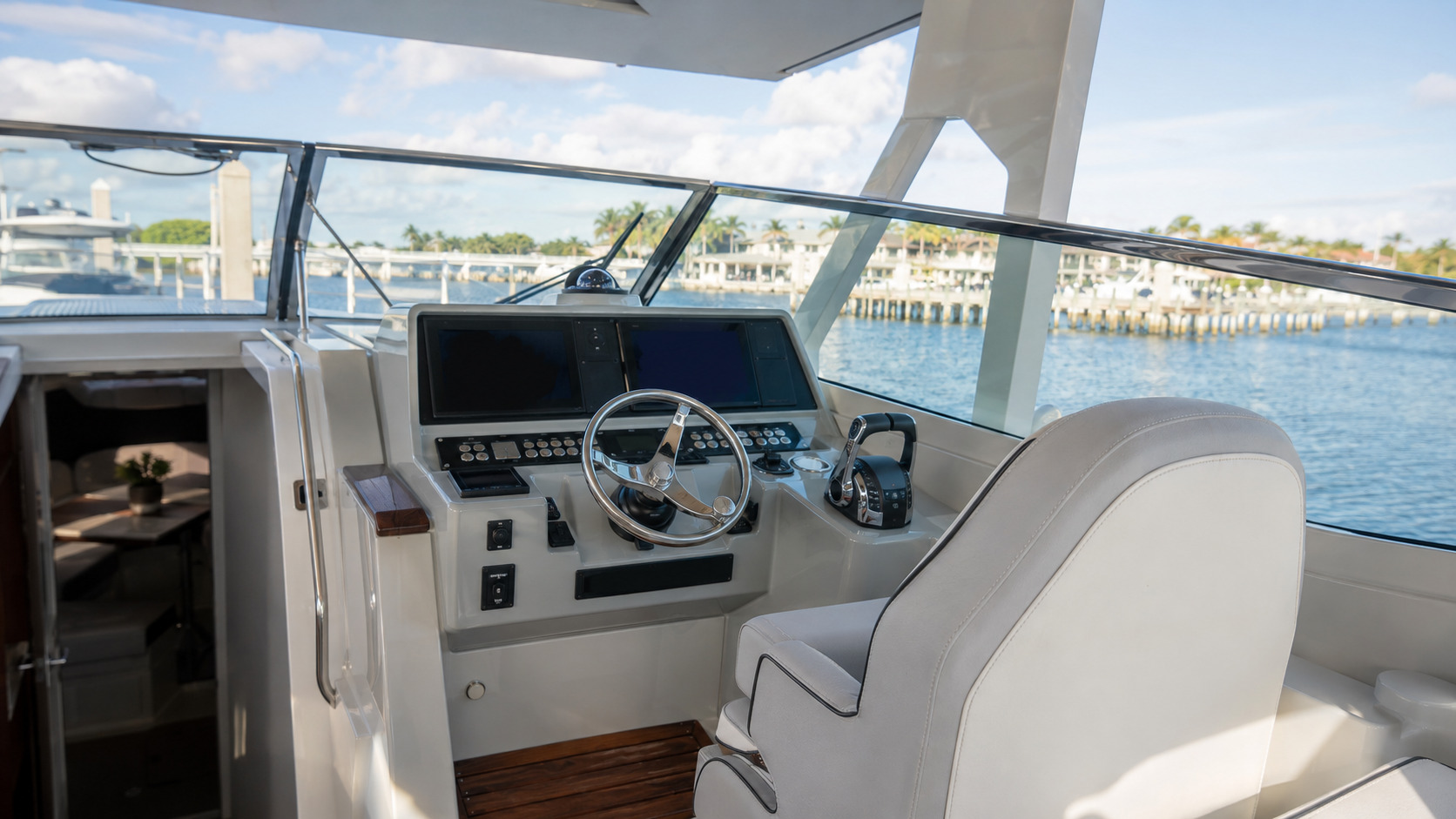
pursuit boats offshore os 355 helm detail 06
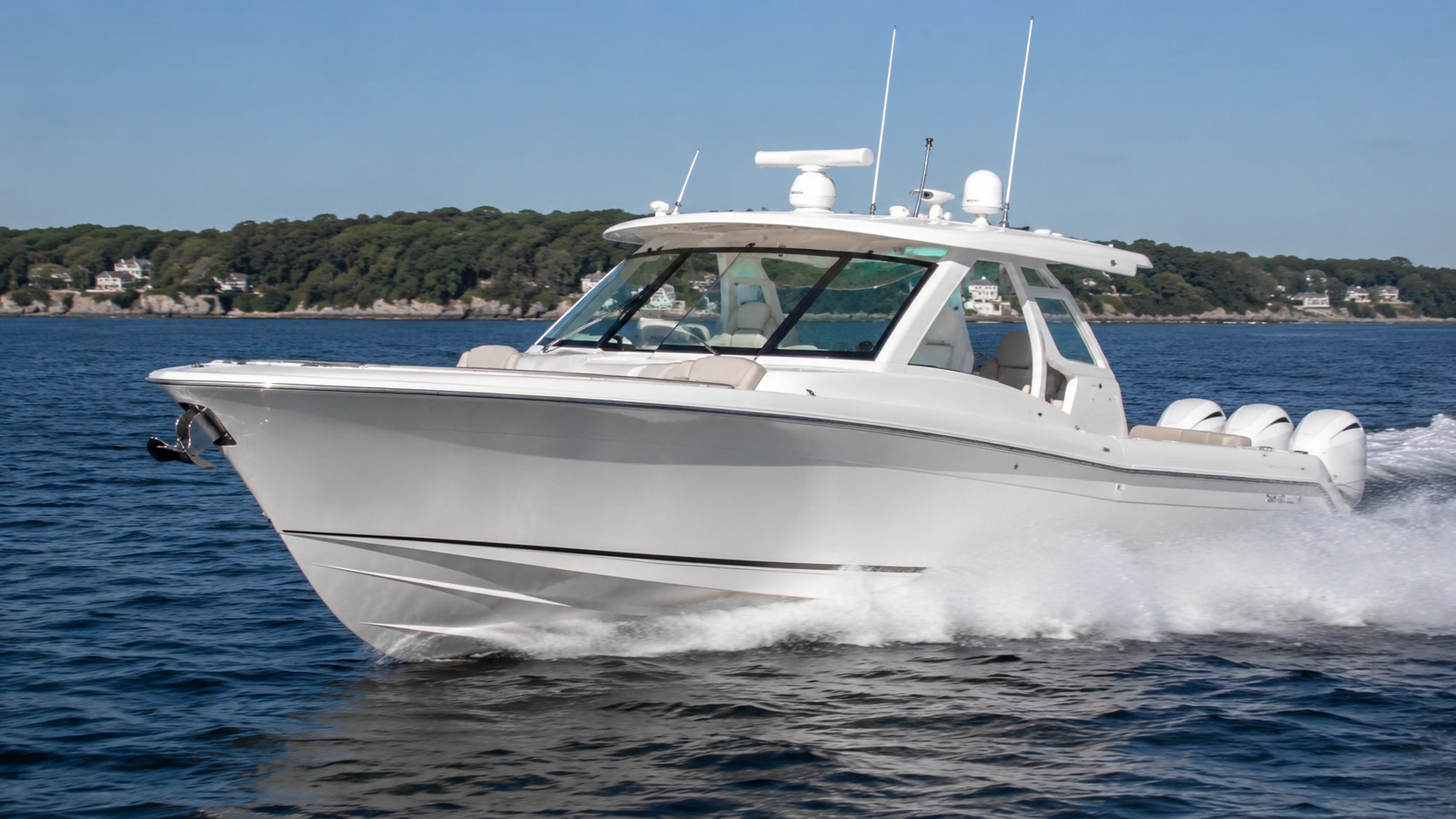
pursuit boats offshore os 355 hero underway 01
pursuit boats offshore os 355 low waterline running 15
pursuit boats offshore os 355 marina evening profile 23
pursuit boats offshore os 355 offshore fishing ready 24
pursuit boats offshore os 355 premium exterior hero 25
pursuit boats offshore os 355 premium marina arrival 13
pursuit boats offshore os 355 quiet cove anchored 21
pursuit boats offshore os 355 rear quarter running 03
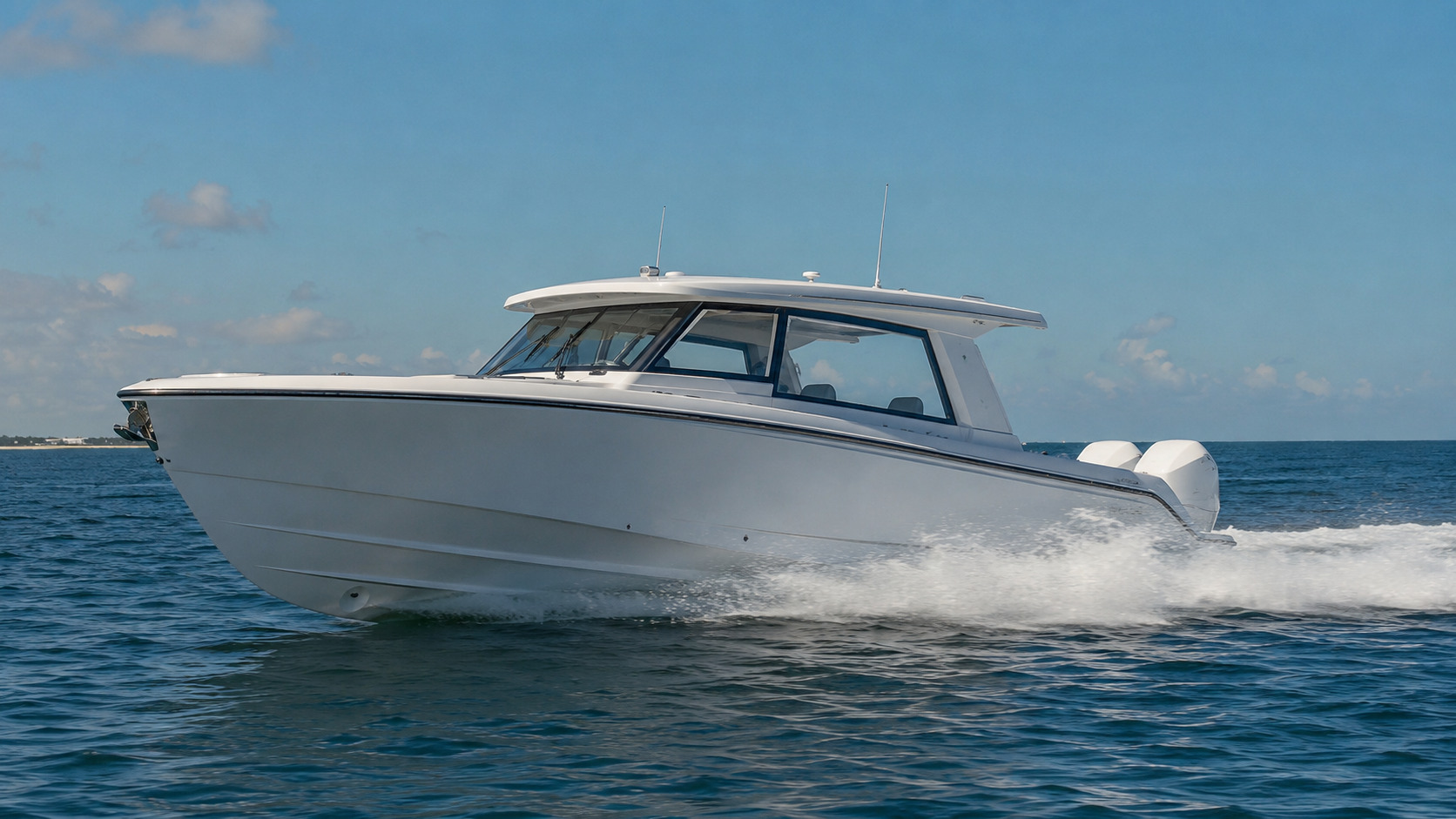
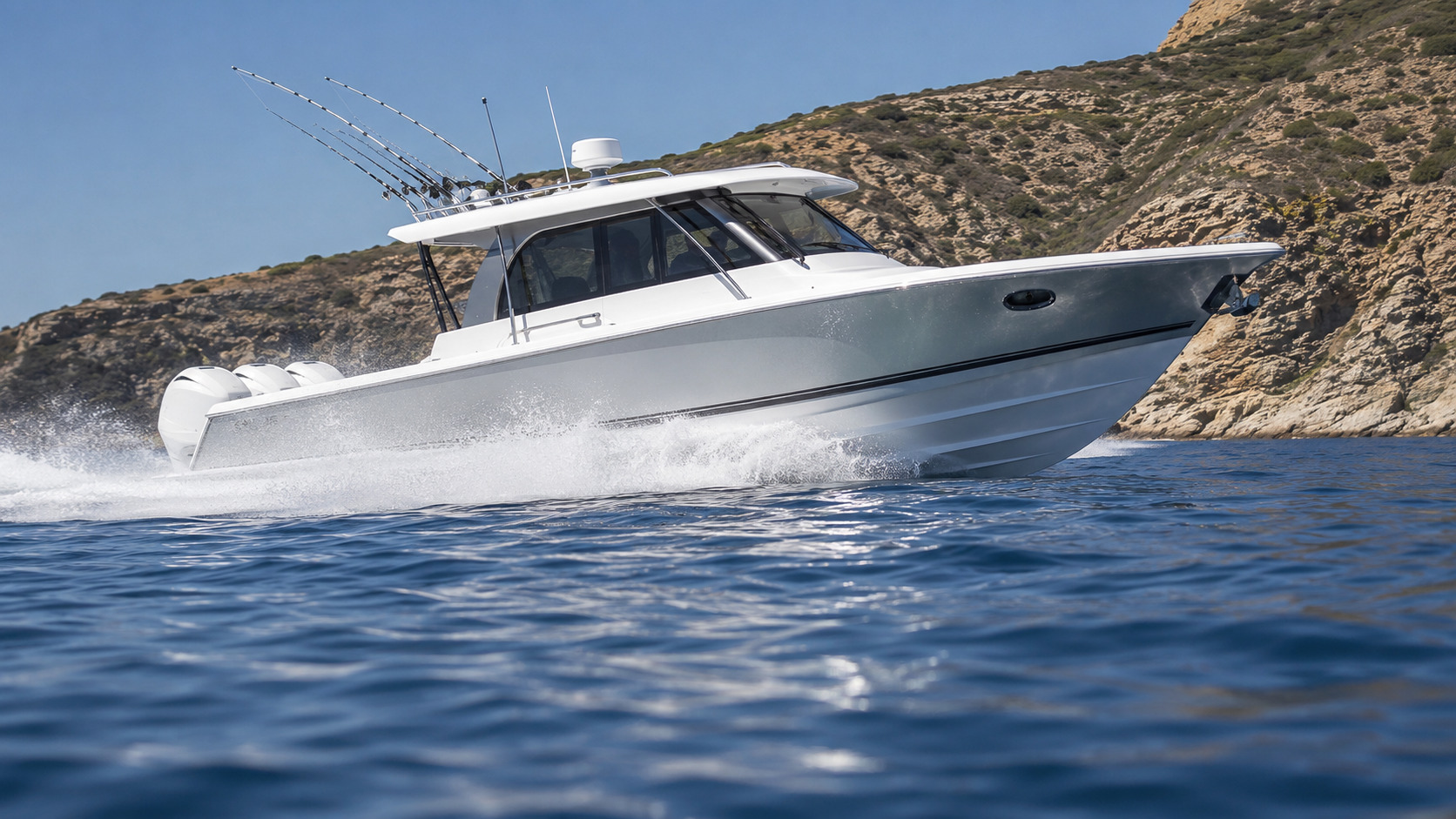
pursuit boats offshore os 355 side profile underway 12
pursuit boats offshore os 355 stern boarding angle 11
pursuit boats offshore os 355 sunset flagship angle 14
pursuit boats offshore os 355 transom outboards detail 20
pursuit boats offshore os 355 aft cockpit social 17
pursuit boats offshore os 355 berth sleeping angle 09
pursuit boats offshore os 355 bluewater cruising profile 22
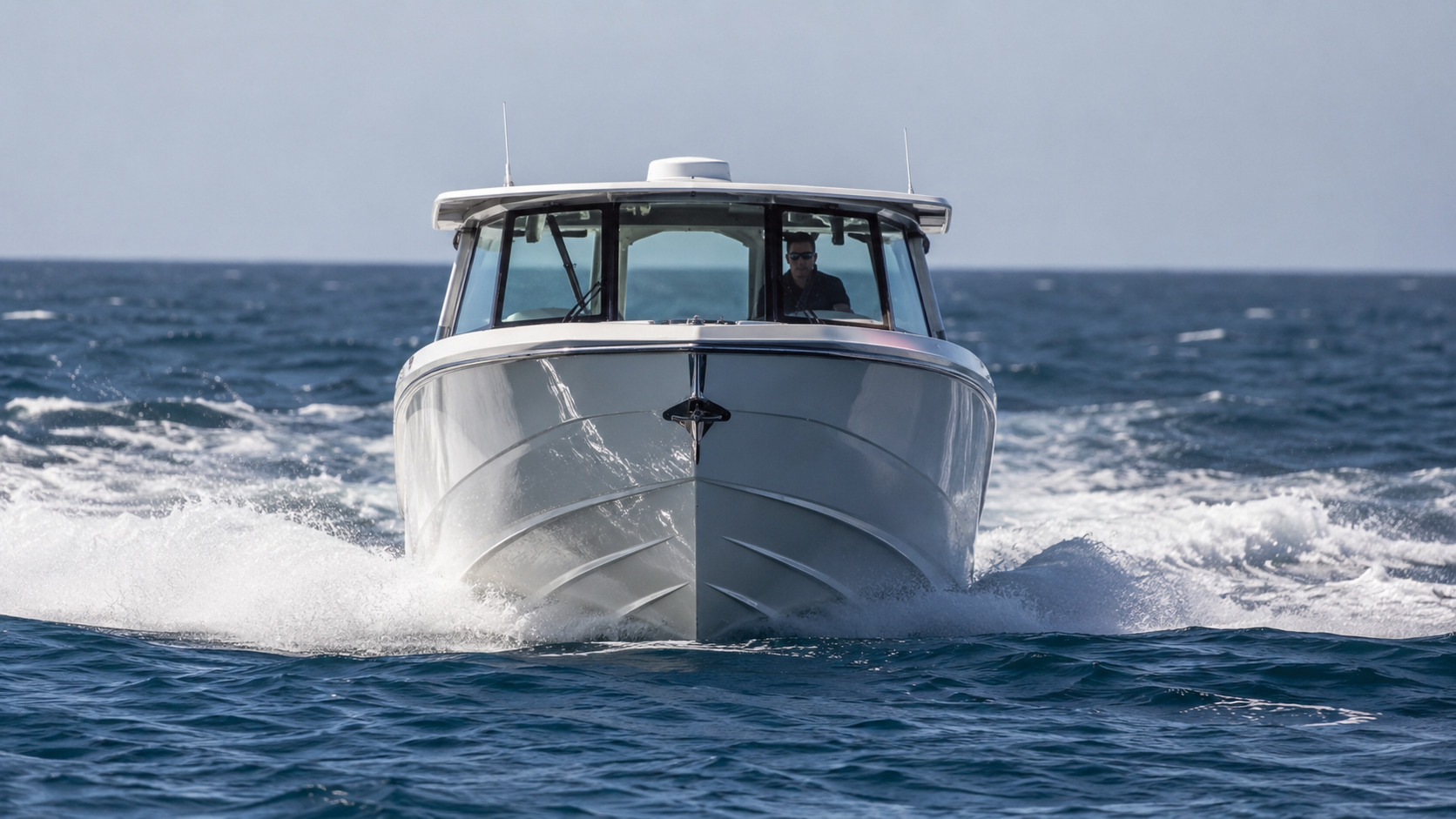
pursuit boats offshore os 355 bow on offshore 16
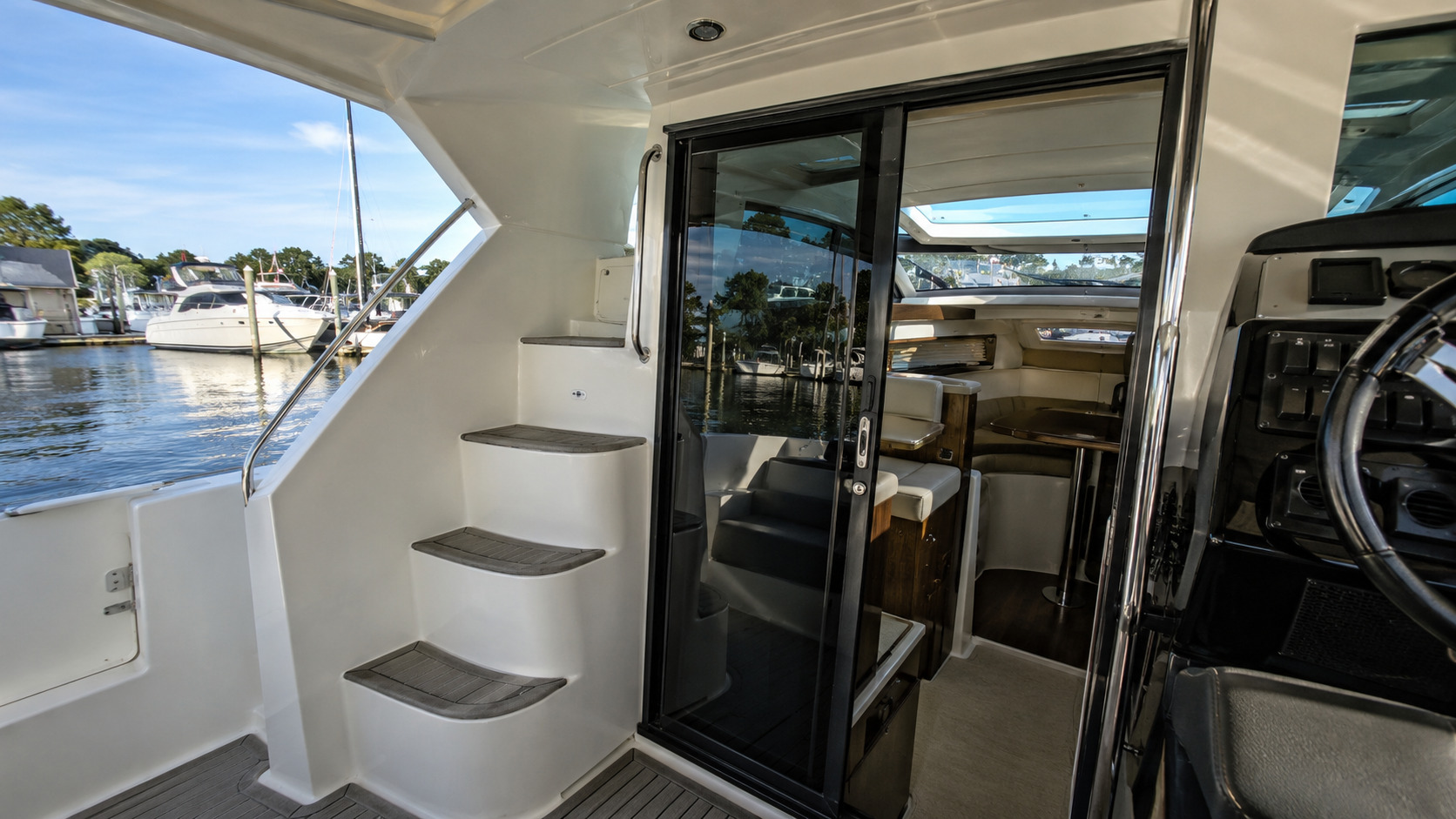
pursuit boats offshore os 355 cabin door companionway 19
pursuit boats offshore os 355 cabin interior 08
pursuit boats offshore os 355 cockpit seating fishing angle 07
pursuit boats offshore os 355 dockside luxury profile 04
pursuit boats offshore os 355 elevated wide exterior 05
pursuit boats offshore os 355 front quarter offshore running 02
pursuit boats offshore os 355 galley cabin utility 10
Typical Pursuit OS 355 pricing
On an OS 355, a functioning joystick, current electronics package, healthy refrigeration or documented gyro service can justify real money. Engine records carry extra weight because the boat uses triple Yamaha F350.
Triple-engine service, generator hours and cabin condition are the three biggest value lenses on a used OS 355. Electronics can be replaced, but a pattern of deferred maintenance across engines and hotel systems is more concerning. A boat with documented care and slightly higher hours may be the better purchase than a low-hour example that sat closed up and unused.
Market price band
Pricing on request
Estimated monthly
Ask us for a payment
Illustration only and not an offer of credit.
Estimate a Pursuit OS 355 payment
Final rate, term, down payment and eligibility depend on the borrower, the OS 355 being purchased and the transaction structure.
Illustration only and not an offer of credit. Your actual rate and term depend on credit profile, vessel age, loan amount and ownership structure.
Compare the OS 355 with nearby Pursuit models
The OS 325 is the first comparison when the buyer wants lower operating scale and twin-engine simplicity. Against the OS 355, those differences change more than performance; they change crew space, service burden and where the boat fits physically. Look at the OS 405 when the buyer wants a significantly larger boat with more interior separation and standard stabilization. The DC 365 belongs on the list when the buyer wants more open-bow day-boating flexibility with a smaller cabin emphasis. The OS 355 should remain the choice only when its own case stays clear after those comparisons: It is large enough to feel like a cruising boat below deck while keeping a fishable cockpit, 28-gallon livewell and twin 45-gallon fish boxes above.
The size comparison with the OS 325 is worth putting on paper. The OS 355 is 37′ 11″ long with 12′ 0″ of beam, while the OS 325 is 34′ 6″ with a 10′ 10″ beam. Fuel capacity is 388 gal versus 300 gal. Those differences can affect dockage and operating cost just as much as they affect cockpit space.
Start an OS 355 purchase by confirming what the boat actually is. The OS 355 is affordable when the buyer can purchase it and still maintain the systems that made it desirable.
The OS 355 is most persuasive when the buyer has outgrown the 325’s interior but does not need the 405’s yacht-scale platform. Spend enough time aboard to learn whether the 12-foot beam and bigger cabin genuinely change the trip. If they do, the third engine and larger systems burden have a reason to exist. If they do not, the 325 remains the cleaner ownership proposition.
The specifications on this guide describe the current or reference OS 355 configuration used for comparison. Pursuit equipment can change by model year, and engines or options may differ on an individual boat. Before closing, verify the hull identification, the installed triple Yamaha F350 package and every high-value option that influenced the price.