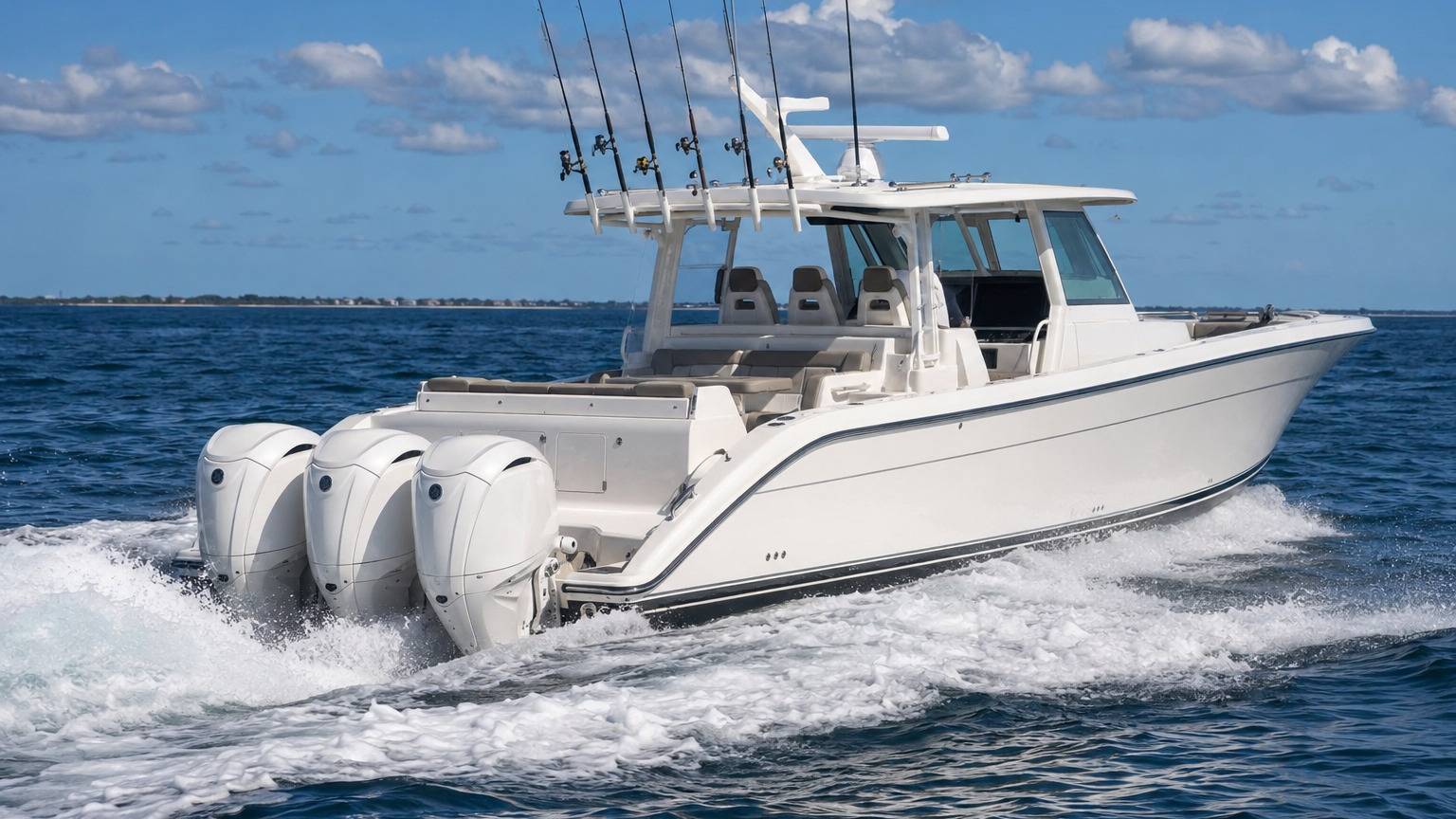
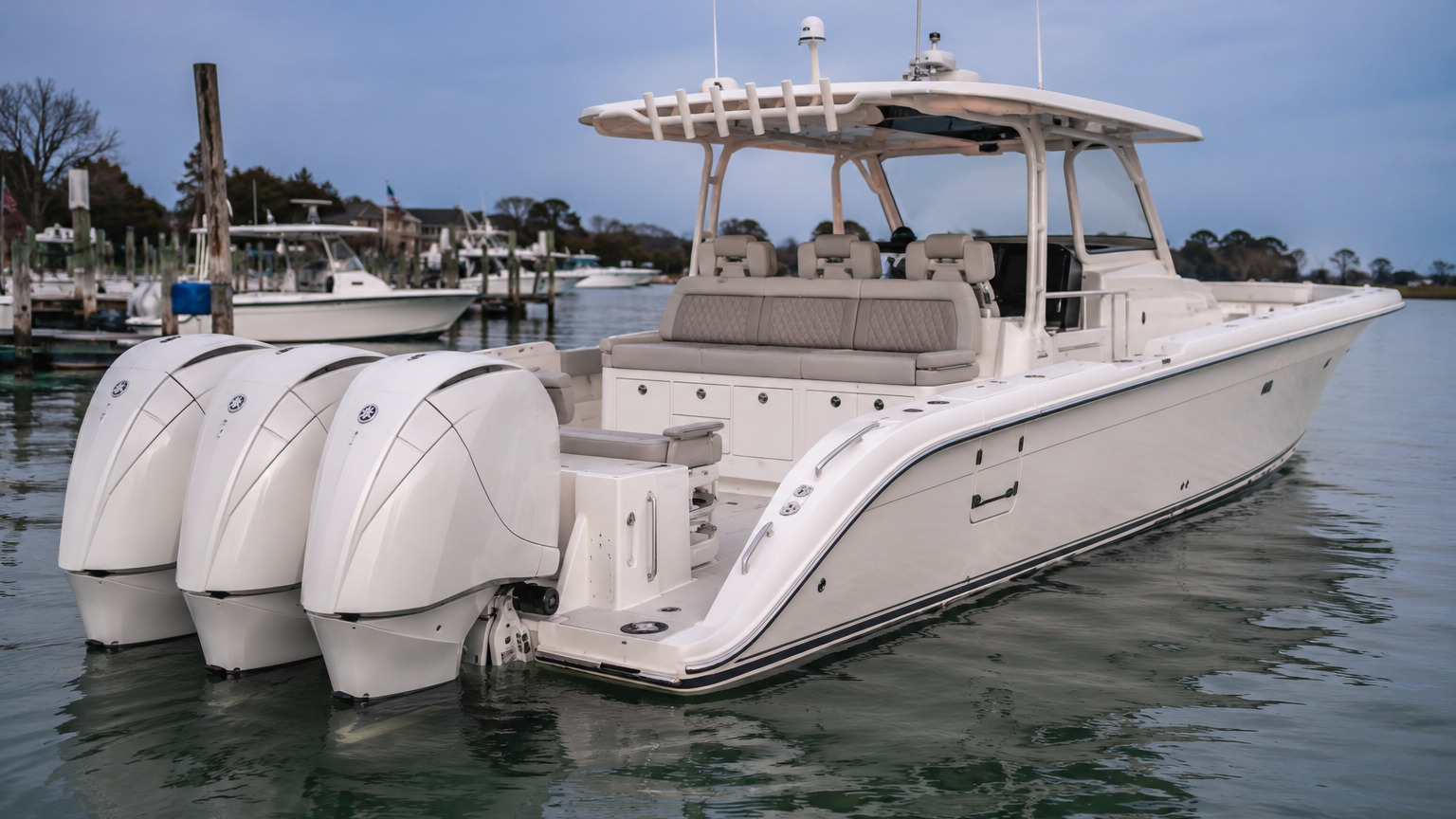
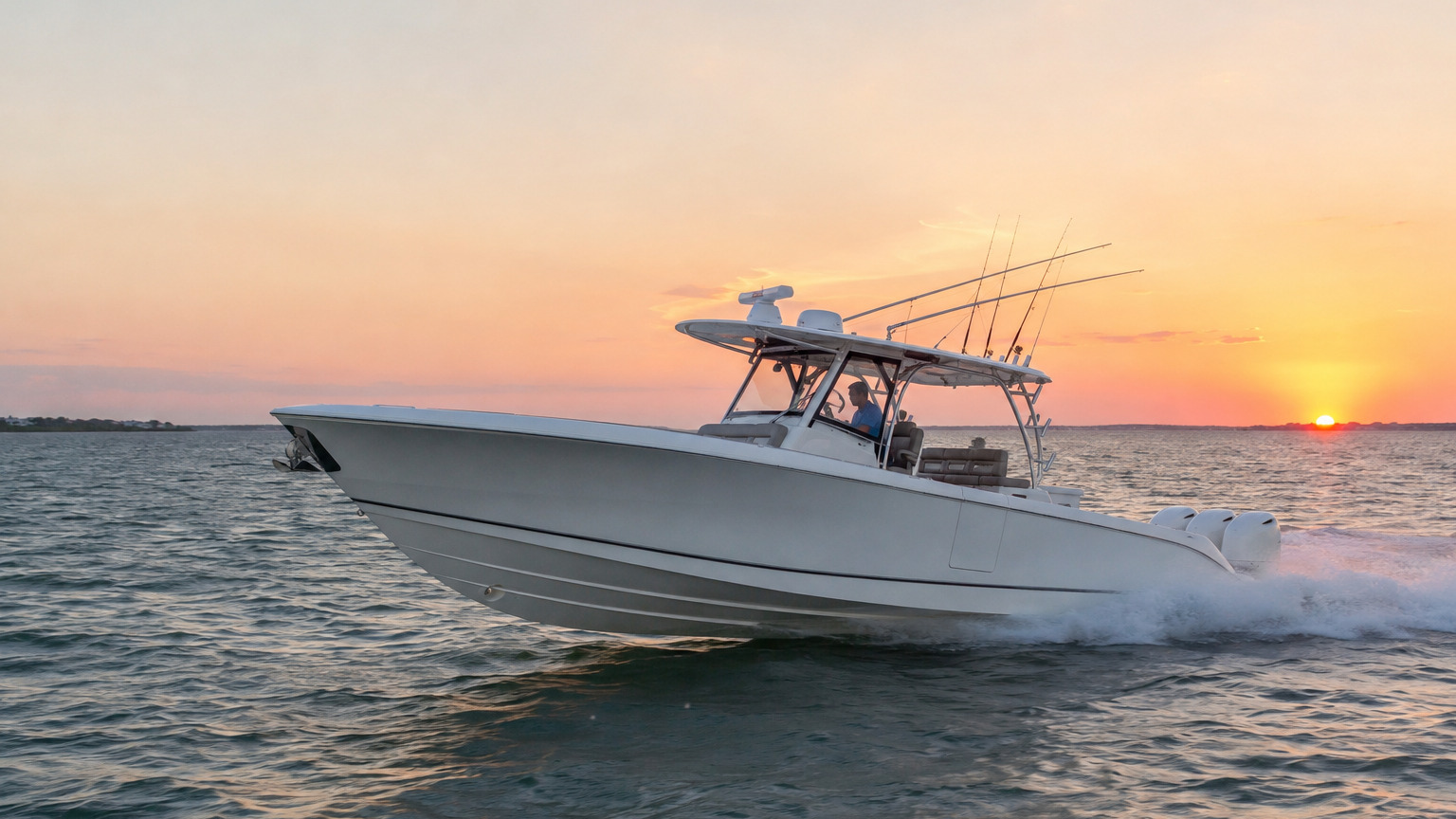
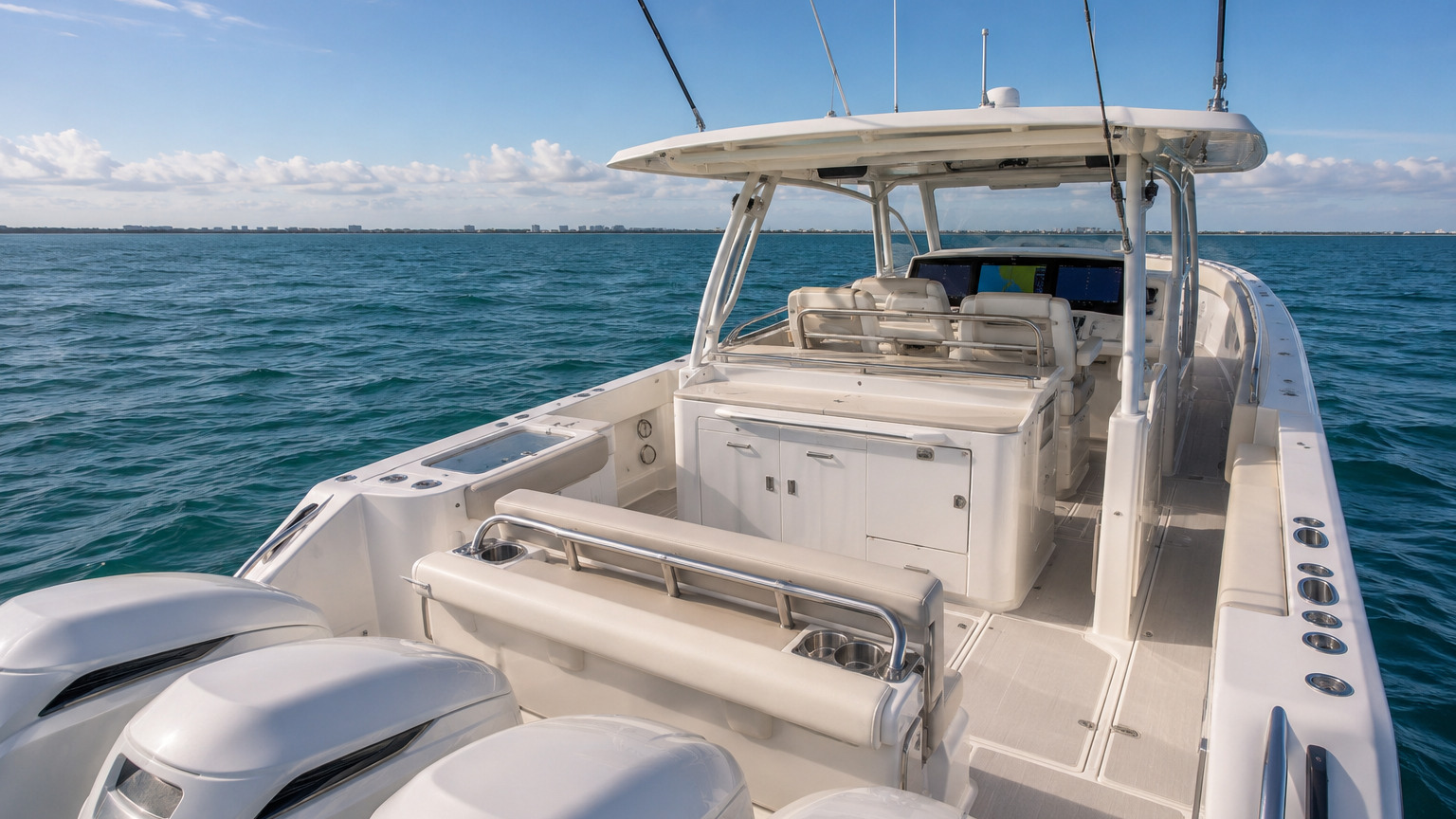
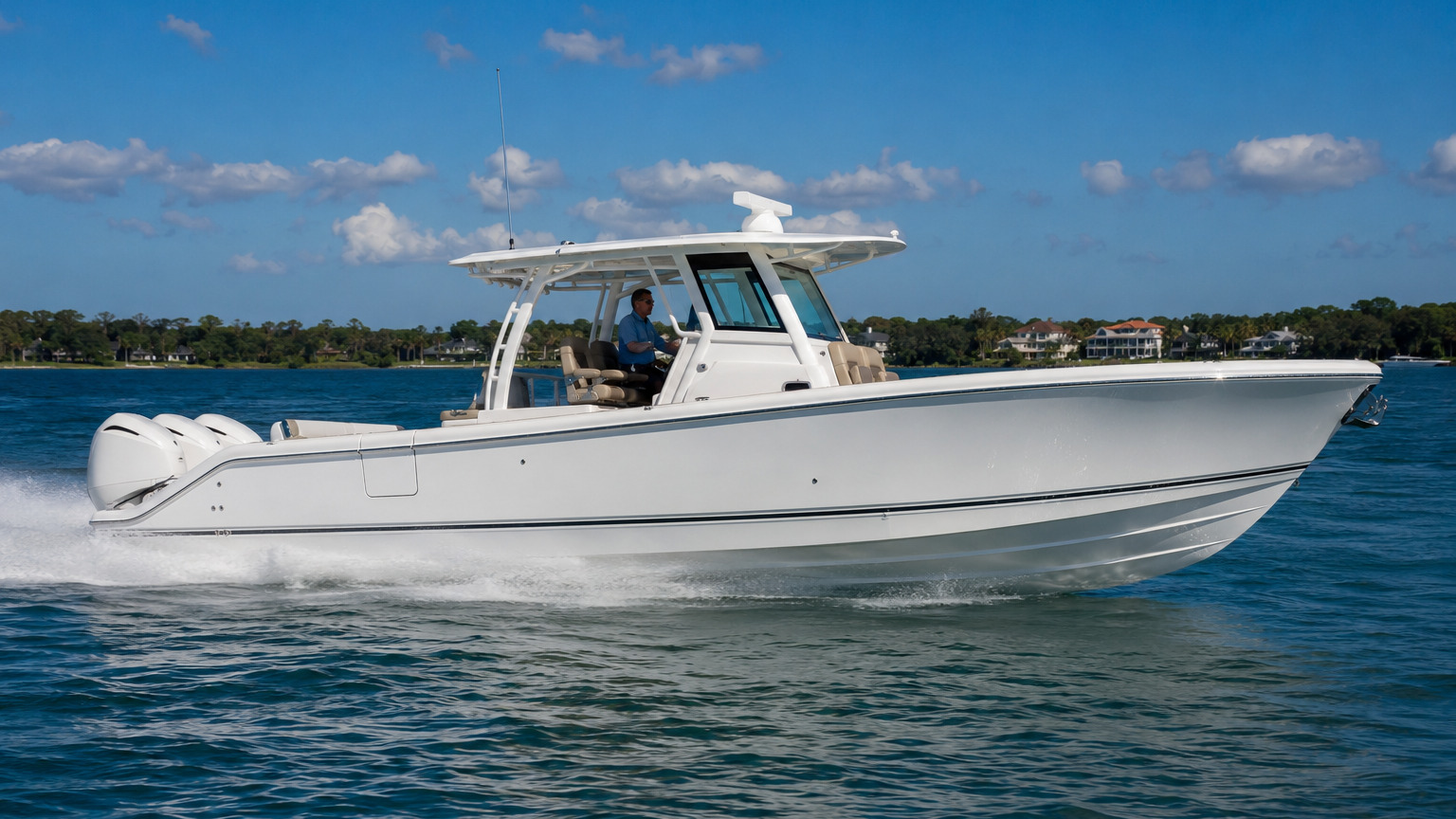
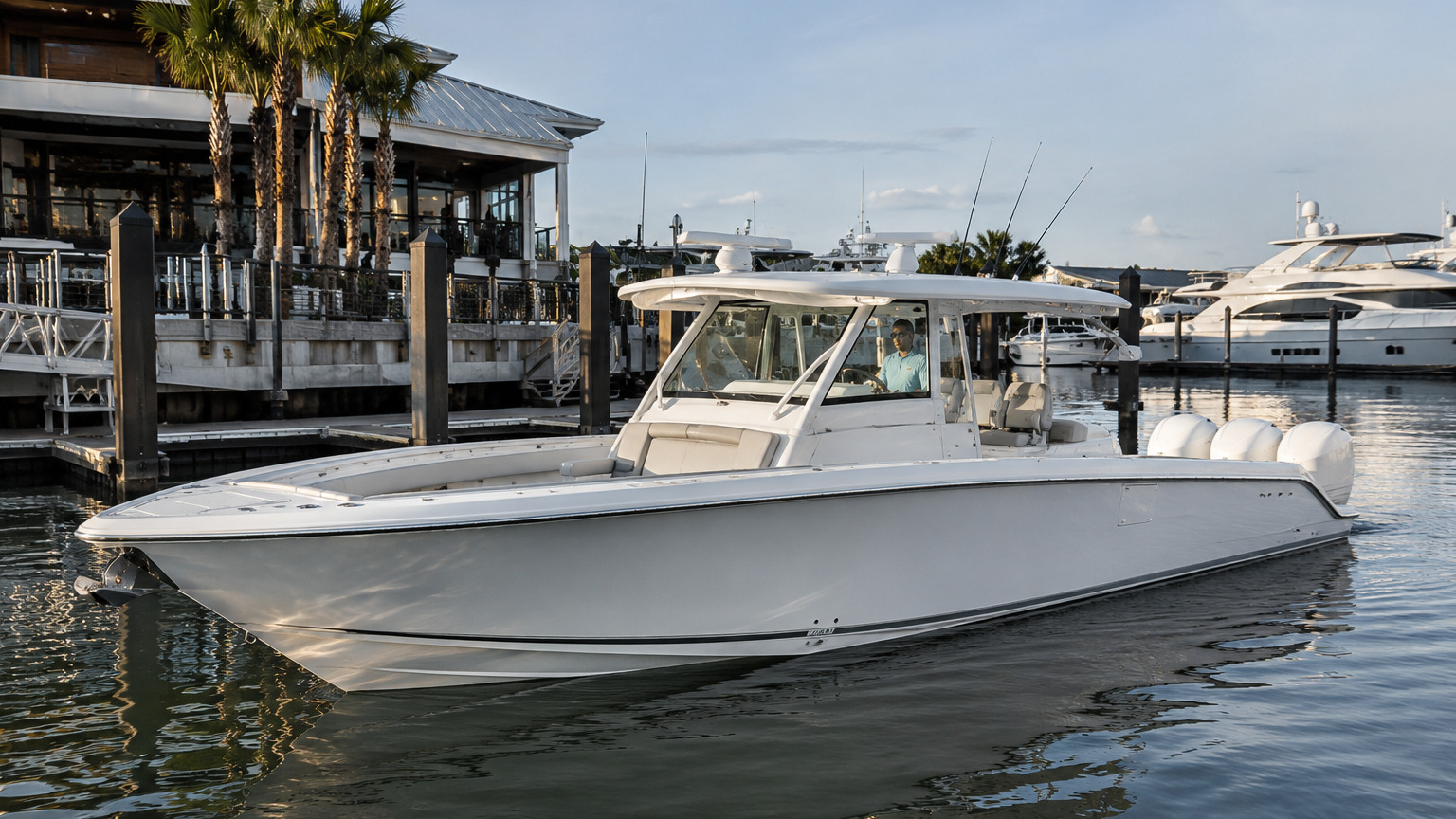
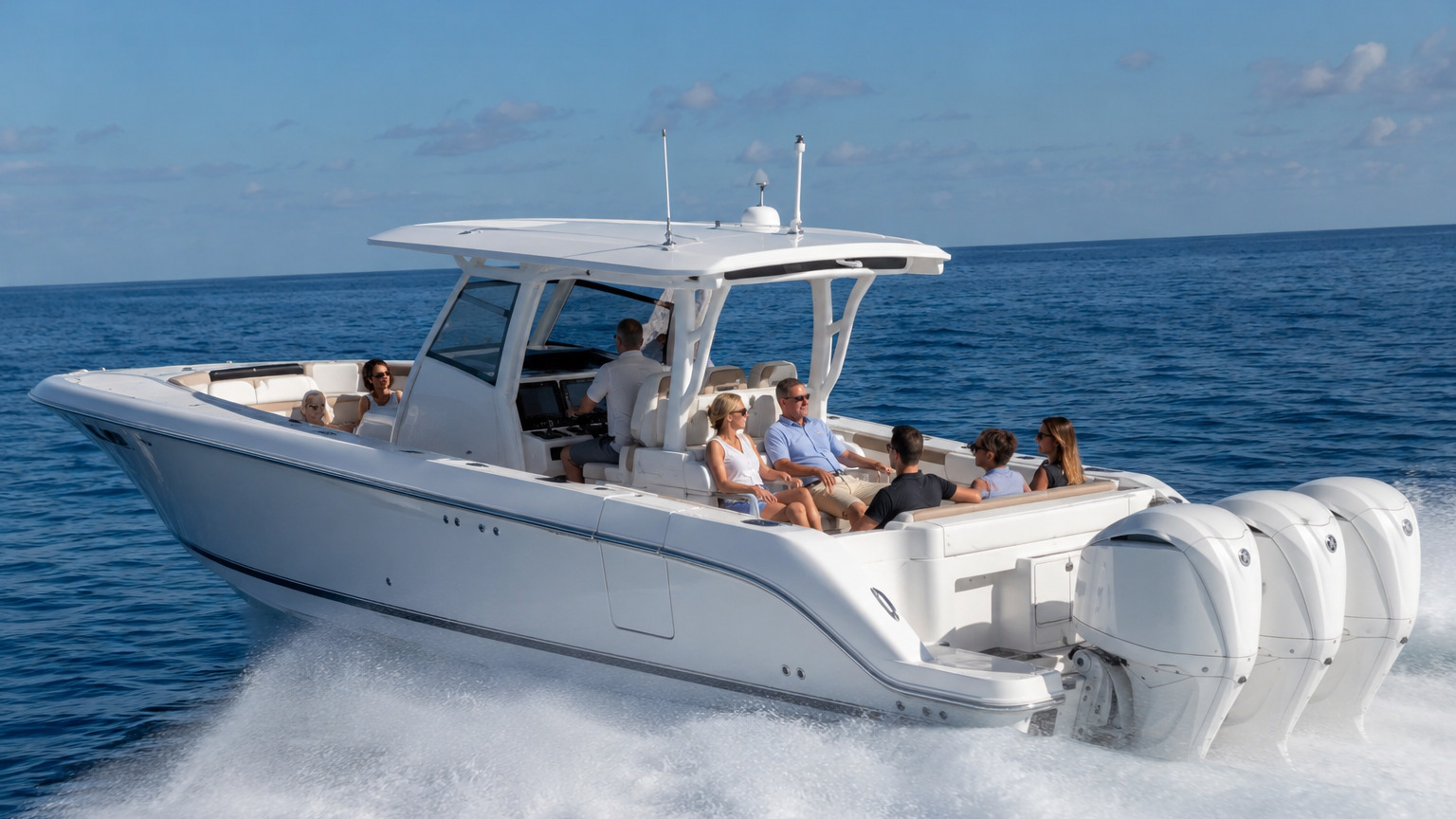
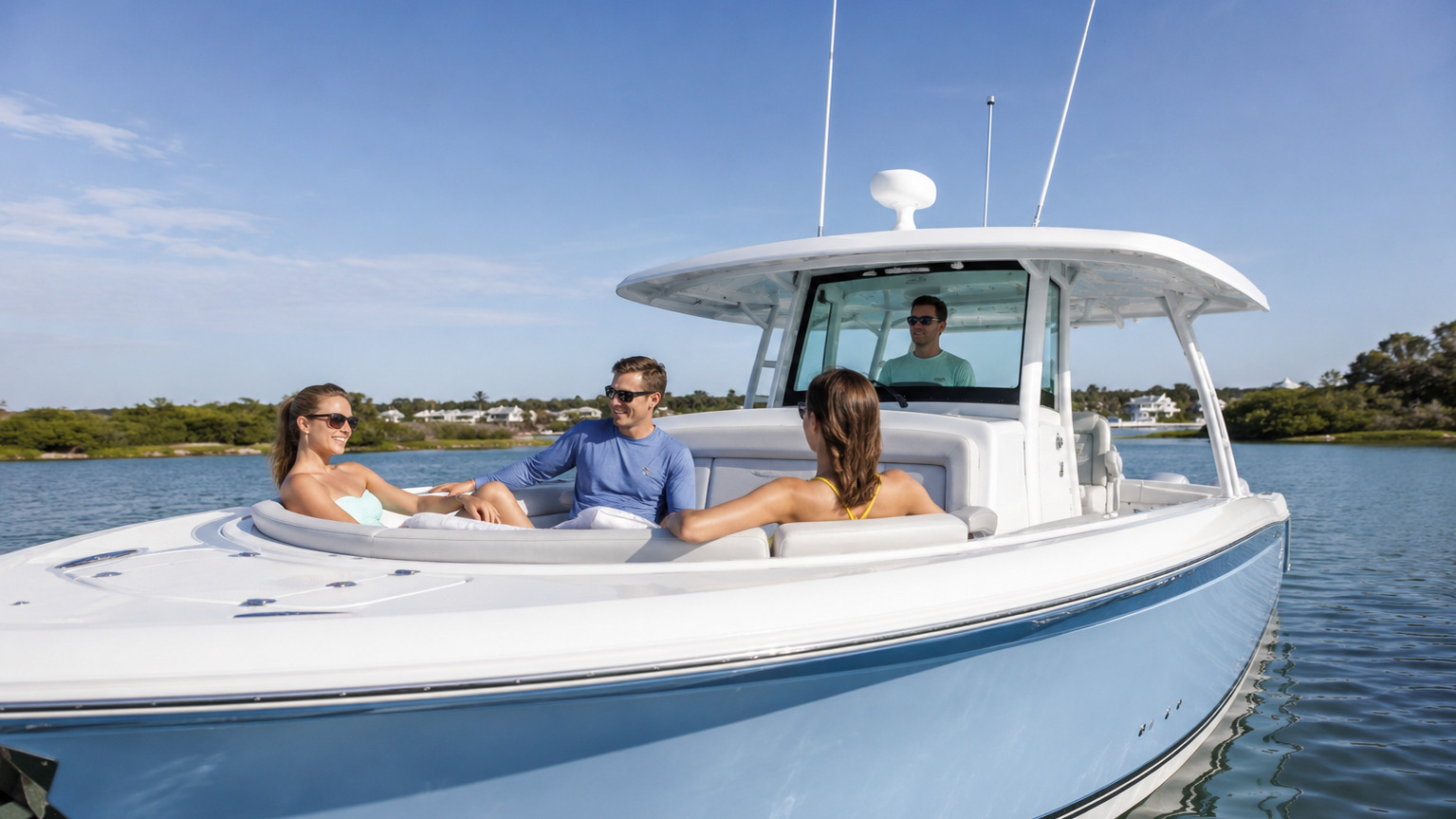
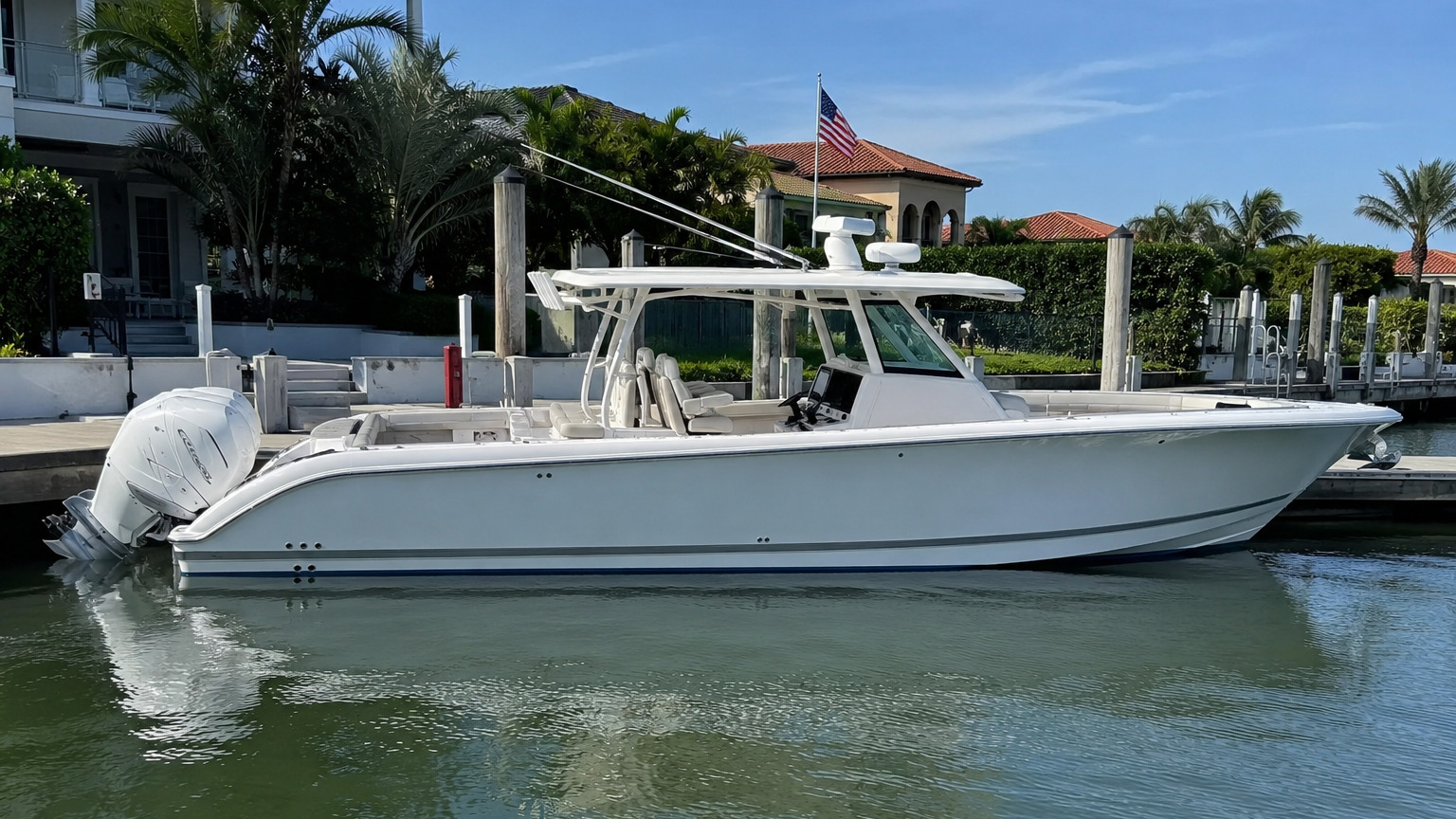
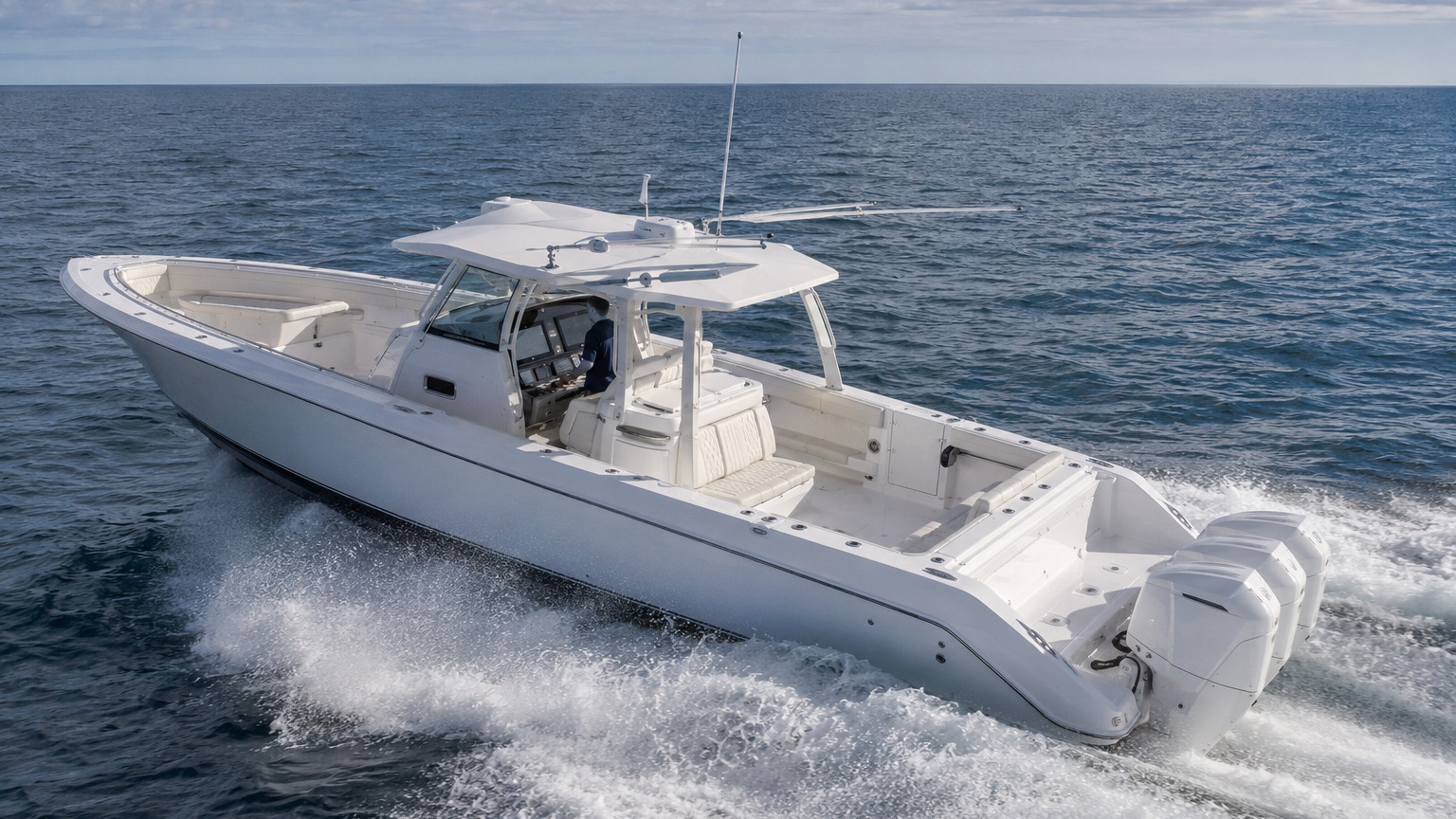
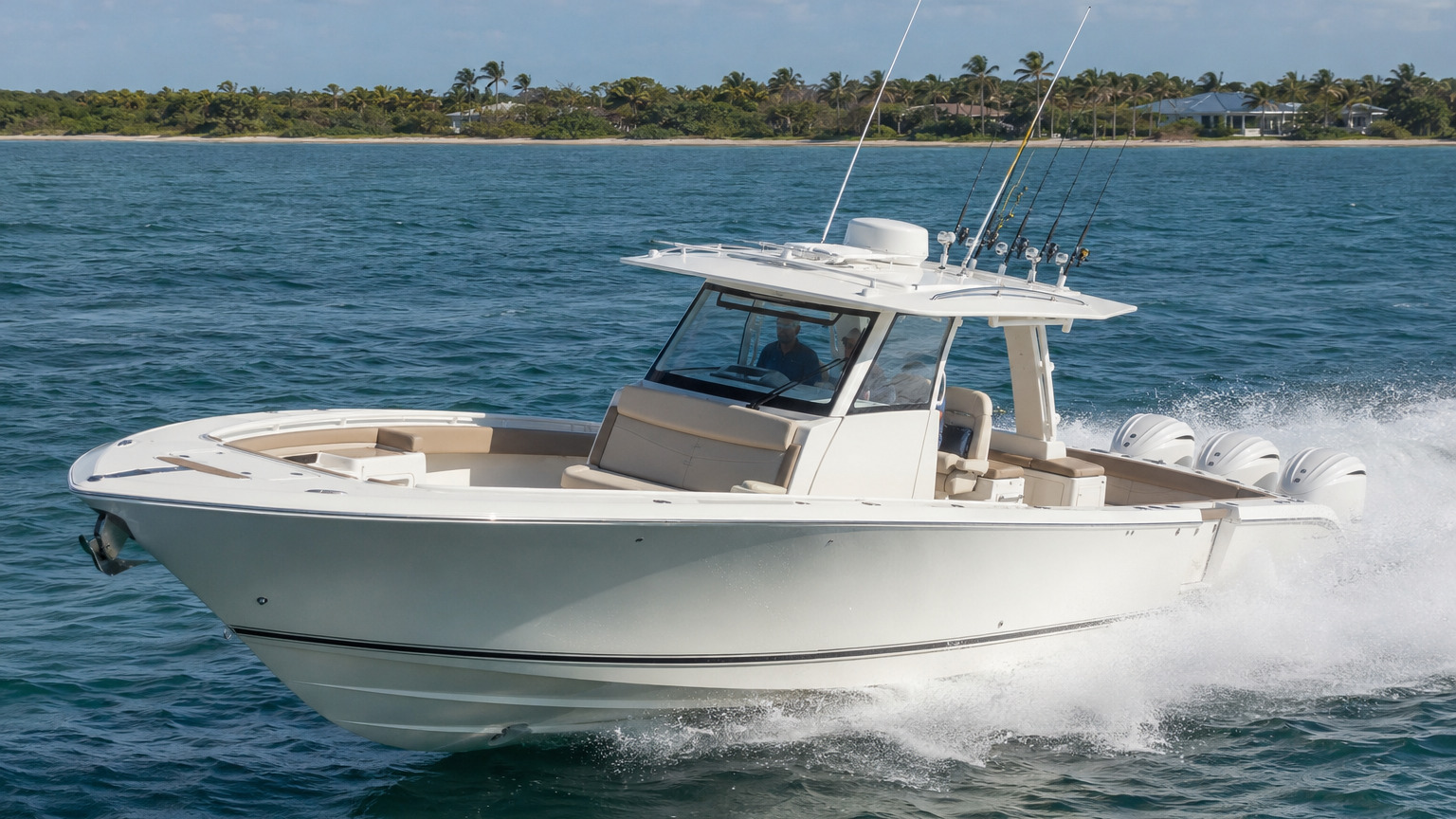
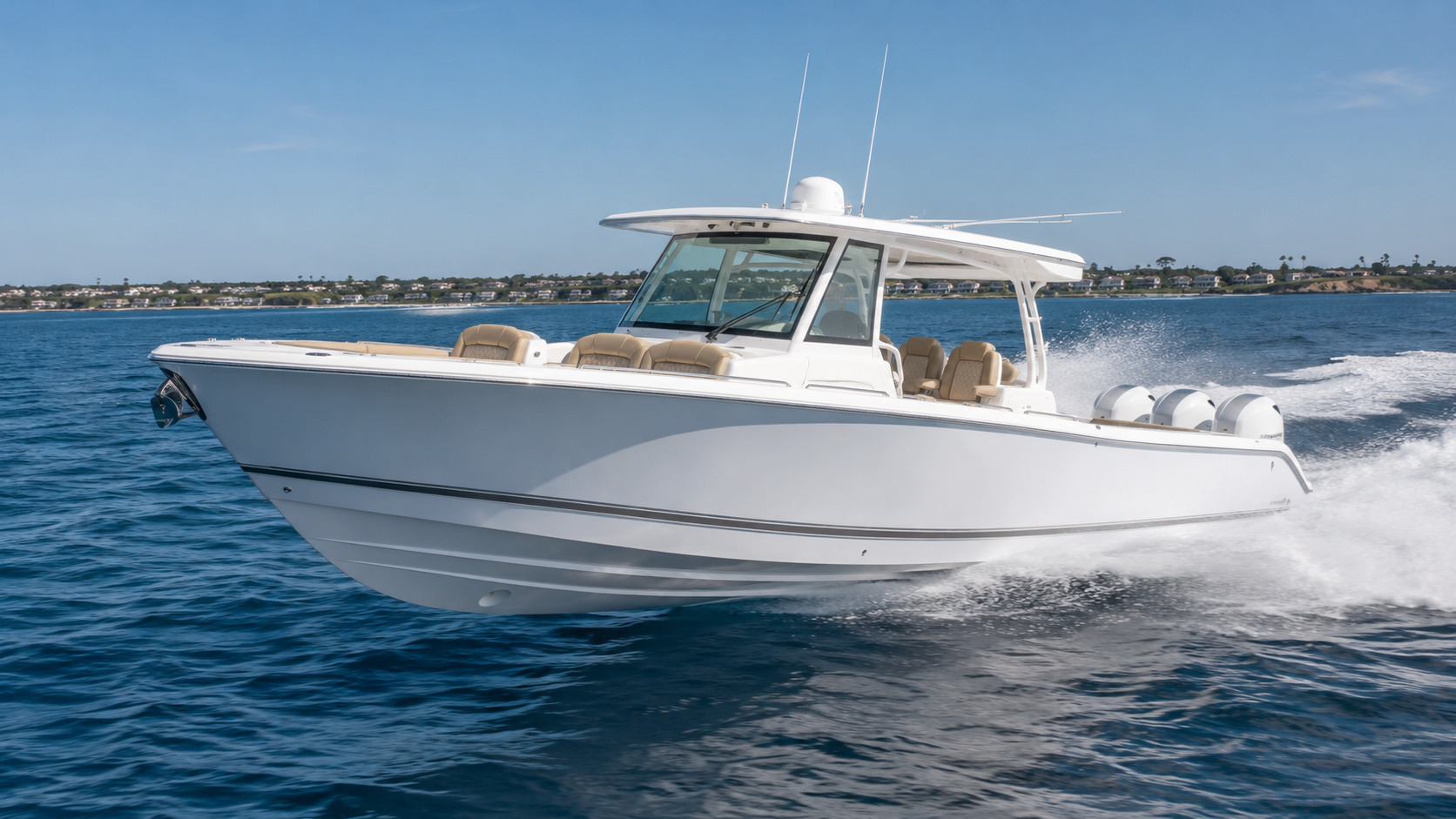
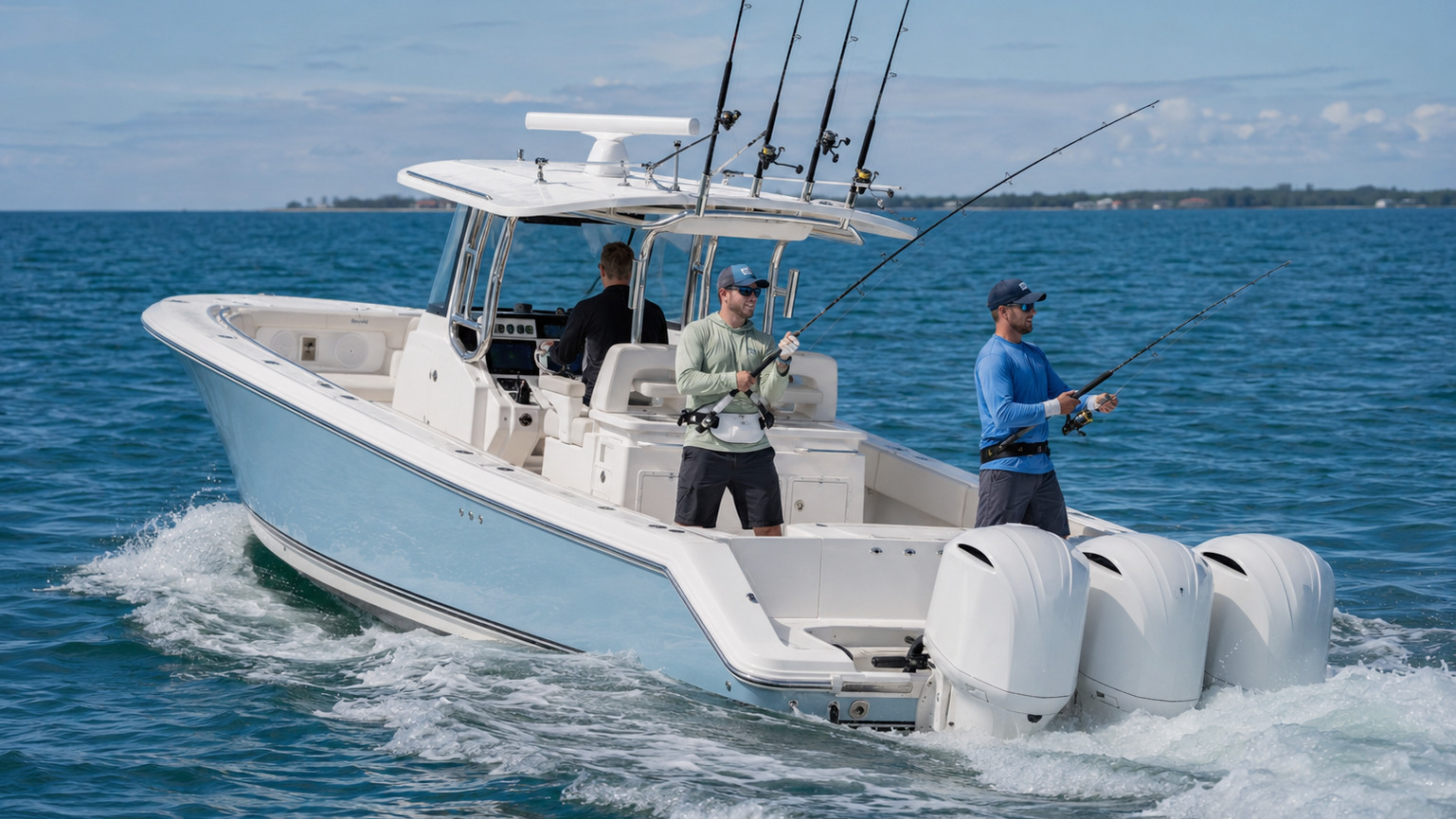
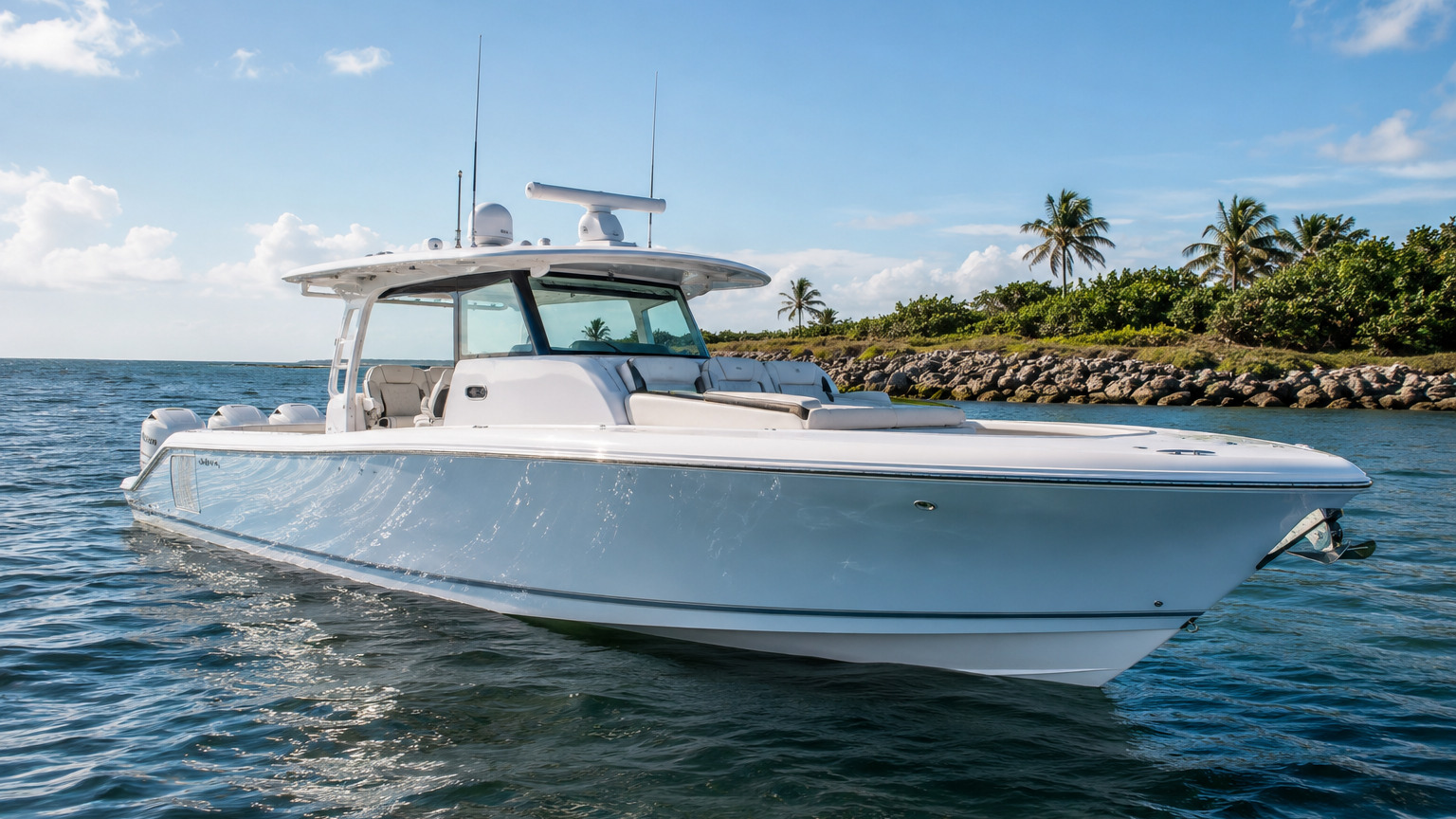
The Pursuit S 388 is the current large Sport center console that replaced the S 378, adding a raised mezzanine, expanded storage and a more fully developed cabin while retaining triple 450 power.
Buyers tend to notice the finish and layout first on a Pursuit S 388, but the better place to begin is mission. This boat is the current large Sport center console that replaced the S 378, adding a raised mezzanine, expanded storage and a more fully developed cabin while retaining triple 450 power. It works best for offshore anglers and families who want a 40-foot-class center console with serious cabin comfort but do not need the quad-engine scale of the S 428. At 41′ 1″ overall and 12′ 0″ of beam, with about 21,700 lb of dry weight, the S 388 has enough physical presence to demand a realistic storage and service plan. It carries 500 gal of fuel and accepts up to 1,350 hp. More important than the raw numbers is the reason they are packaged this way: A 12-foot beam, 500-gallon fuel tank, triple 450s and a redesigned console cabin place the 388 much closer to a crossover yacht than a conventional open center console. The S 388 is easier to manage than the flagship 428, but 21,700 pounds dry and 500 gallons of fuel still require yacht-level dockage, service planning and operating budget. Use the S 378 as the first check when the buyer wants the late-model predecessor with similar beam and less updated storage. The S 428 belongs in the conversation when the buyer wants more beam, quad power and flagship capacity. Consider the OS 405 when the buyer wants more enclosed overnight comfort and express-cruiser protection.
The S 388 takes the large Sport concept and modernizes the areas owners use constantly: mezzanine seating, tackle storage, cabin layout and refrigeration. Triple 450 XTOs and 500 gallons of fuel give it serious offshore reach, but the boat is just as much about making a 41-foot center console comfortable for family use. The strongest buyer is someone who will use both sides of that equation rather than treating one as backup.
The running surface on the S 388 finishes at 22° of transom deadrise. Beam is 12′ 0″, while published draft ranges from 2′ 8″ engines-up to 3′ 8″ engines-down. At about 21,700 lb dry, this hull should not be evaluated as though that figure represents the boat in the water. The 500 gal fuel tank, freshwater, passengers and equipment all add load. The nearest comparison is the S 378. Put the two boats in the same conditions if possible, because the late-model predecessor with similar beam and less updated storage may matter more than a small difference in asking price.
At 21,700 pounds dry with a 12-foot beam and 22-degree transom, the S 388 carries more mass than its predecessor. That weight should show up as composure offshore, but it also means more inertia around the dock and more demand on haul-out equipment. Use the sea trial to feel the hull at a realistic cruise with fuel aboard, then spend equal time maneuvering slowly.
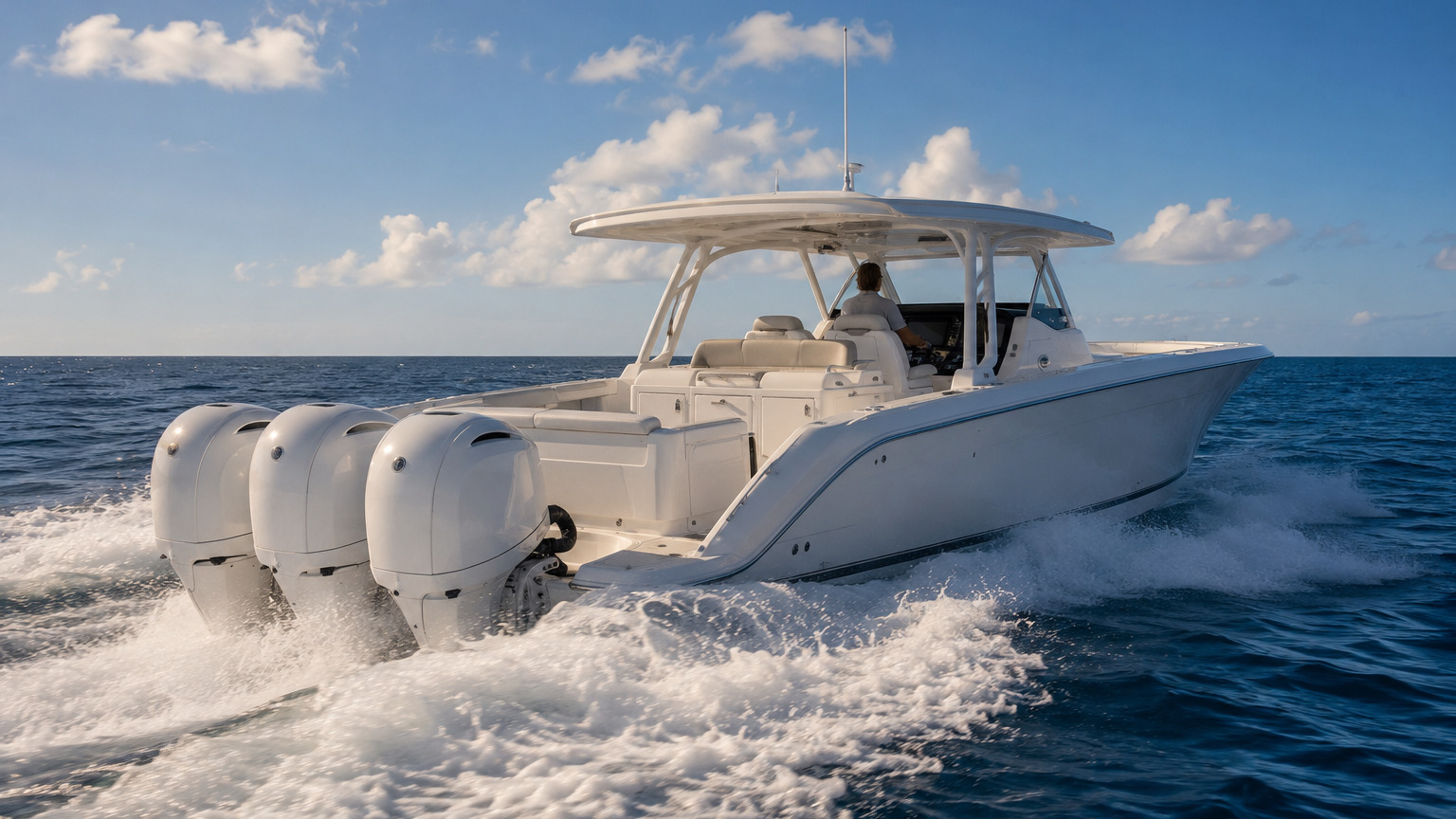
With triple Yamaha 450 XTO and a maximum of 1,350 hp, the S 388 has an engine package chosen for a substantial offshore hull.
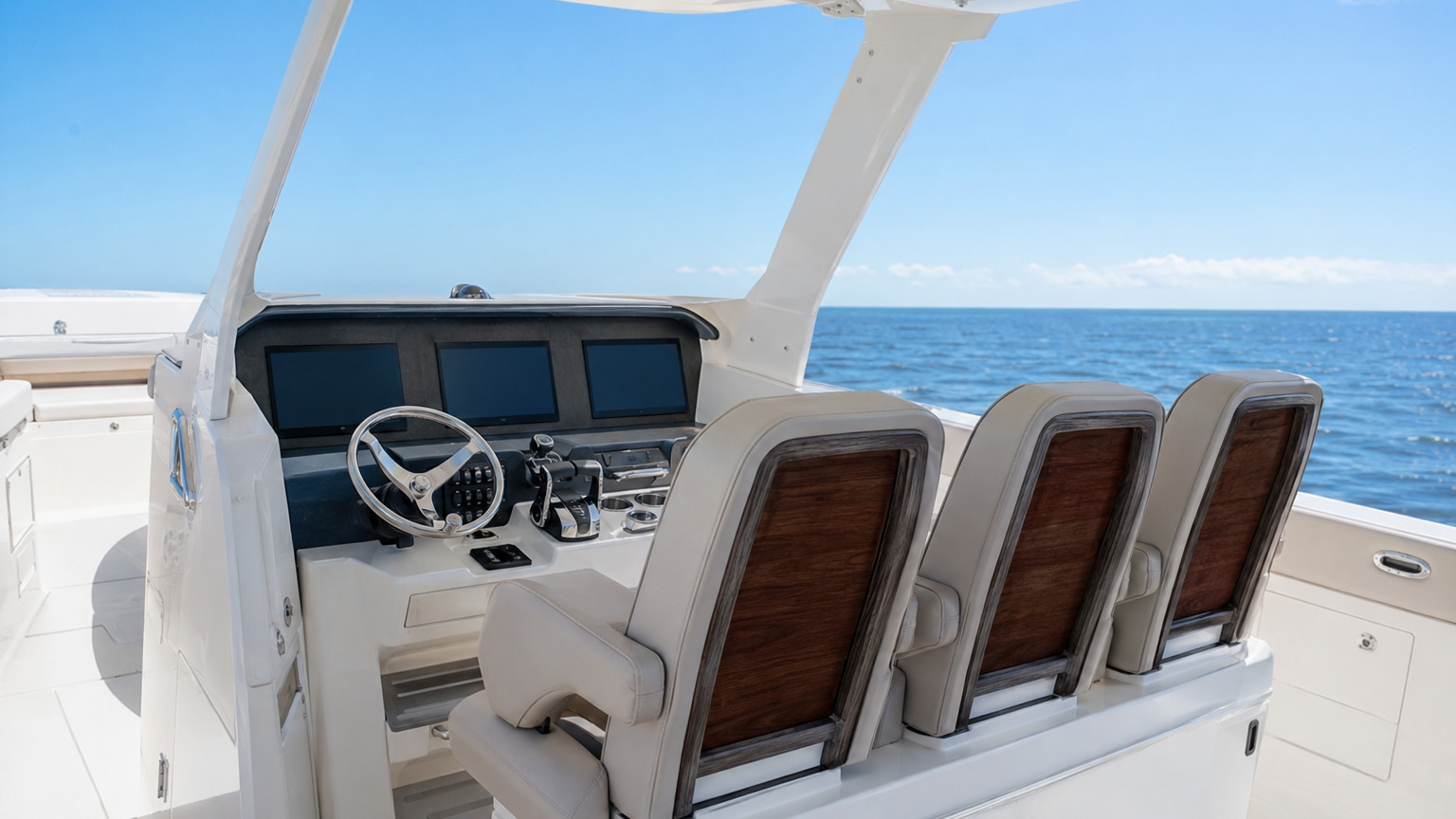
Triple 450 XTOs provide 1,350 horsepower without moving to the S 428’s fourth engine. That engine count is one of the 388’s key advantages over the flagship. Maintenance is still substantial, but the owner avoids a fourth gearcase, propeller and service schedule. Check all three engines as a matched group and verify joystick steering or autopilot functions after the boat is fully warm.
Fuel capacity, cruise planning and operating range
The S 388 carries 500 gal of fuel. Ownership math changes once the S 388 is loaded. The dry figure is about 21,700 lb, and a full 500 gal fuel load adds substantial mass before freshwater, people and gear. That wet condition is the one a lift, haul-out yard or transport plan needs to support. Buyers moving up from a smaller boat should confirm those limits before assuming their current infrastructure will carry the S 388.
Fishing use can make the S 388’s 500 gal tank behave differently from a cruising-only boat. A day may combine a fast run offshore, hours of trolling or repositioning, and a run home in rougher afternoon water. Track those modes separately during ownership planning. The result is a more realistic fuel budget and a safer reserve than assuming the entire day happens at the most efficient cruise rpm.
The S 388 needs to prove two things underway: that the hull is comfortable in the owner’s water and that the driver can manage it without unnecessary effort. Test both. The 22° transom deadrise should be evaluated as part of the complete hull, not used as a marketing score. If the buyer is also considering the S 378 for the late-model predecessor with similar beam and less updated storage, compare visibility, noise and low-speed control as carefully as speed.
For the S 388, performance has to include the fishing day as well as the run offshore. Test the 22° hull with people and gear aboard, then slow down and see how the boat behaves while trolling, drifting or positioning near a spot. The helm should remain predictable as weight moves around the cockpit. Because A 12-foot beam, 500-gallon fuel tank, triple 450s and a redesigned console cabin place the 388 much closer to a crossover yacht than a conventional open center console, the benefit should be visible in normal use rather than only in a short high-speed run. If the S 378 better matches the owner’s priorities, compare it in the same water.
Use the S 388 deck the way the owner will use it on Saturday, not the way it is staged for photography. The details that distinguish this model include Raised triple-wide mezzanine, Triple 450 XTO outboards and 500-gallon fuel tank. Each should feel deliberate.
The raised triple-wide mezzanine is more than a seat. It creates an elevated viewing position while housing tackle and storage beneath. Sit there underway and then open the fishing storage with people nearby. The cockpit entertainment center and large transom cooler should be tested in the same way. The 388 is expensive because its spaces perform multiple jobs; those jobs should not conflict.
500-gallon fuel tank – The range potential is significant, as is the fuel weight and refueling budget.
Raised triple-wide mezzanine
The aft-facing seat improves sightlines and doubles as a major tackle and storage center.
Triple 450 XTO outboards
The power package provides 1,350 horsepower with three engines rather than the S 428's four.
Convertible cabin with opposing settees
The cabin works as a lounge by day and berth by night.
Full cockpit entertainment center
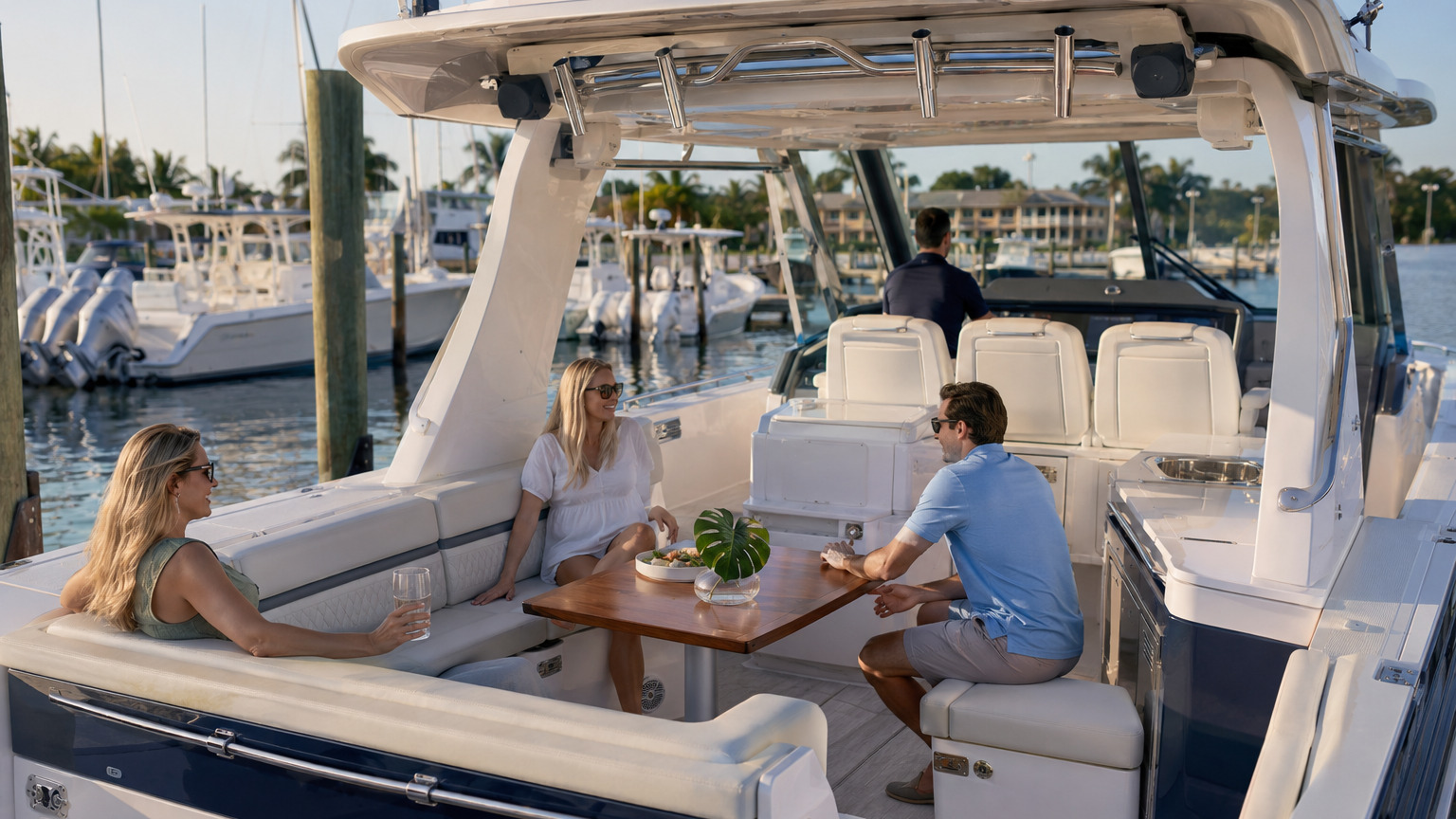
Grill, sink, prep area and storage make the aft cockpit work for both fishing and entertaining.
Large transom cooler
Catch or cold storage is built into the stern without relying on portable coolers.
Electronics, pumps and onboard systems
The S 388 systems check should focus on the equipment that makes this particular model valuable: Raised triple-wide mezzanine, Convertible cabin with opposing settees, Full cockpit entertainment center and 22-degree deadrise. Begin with the electrical foundation.
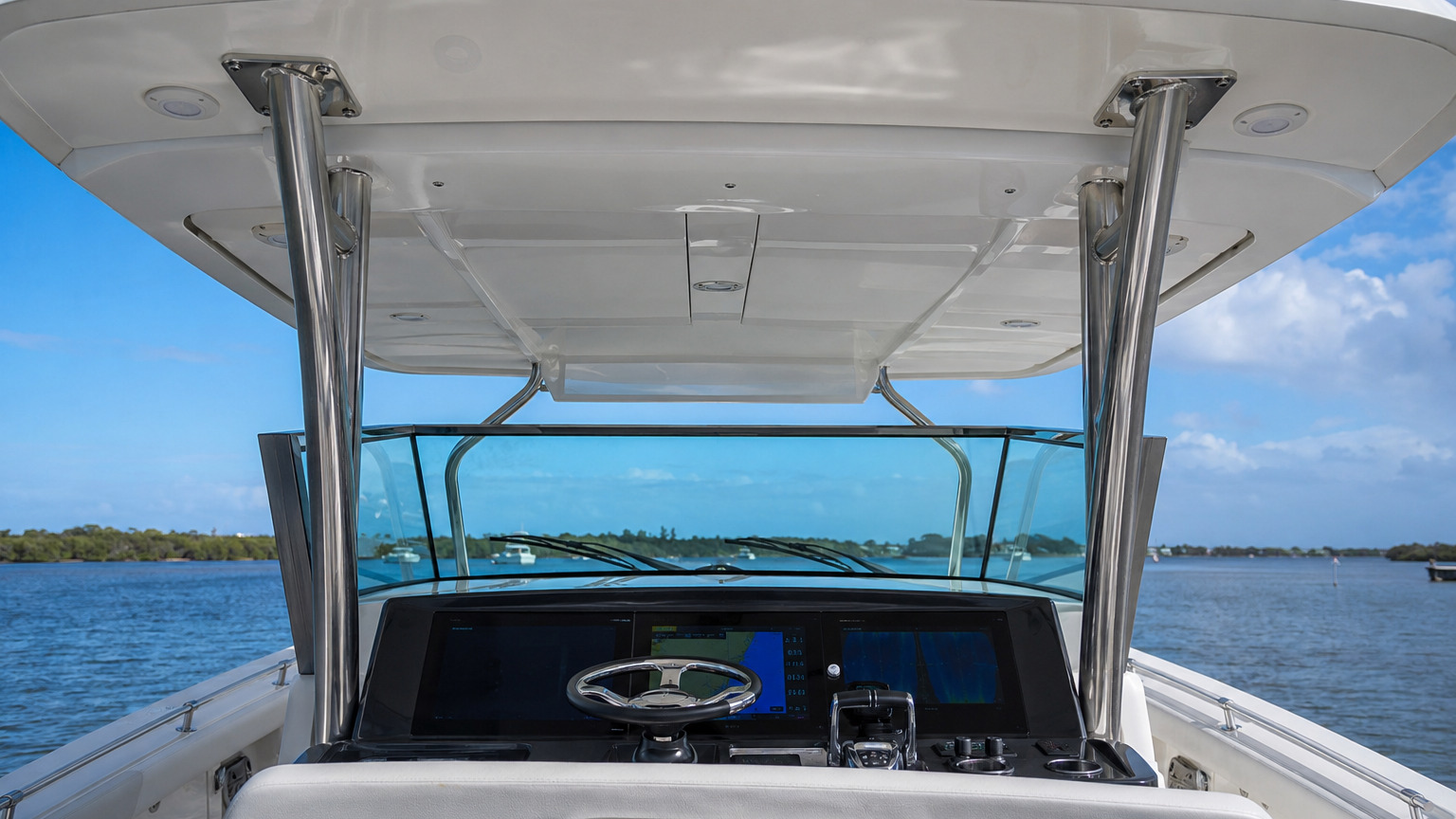
The 388’s electrical load can include triple-engine steering, generator, climate control, multiple refrigerators, entertainment hardware and a large Garmin network. Run a realistic combination instead of checking devices one at a time. Cabin refrigeration is especially worth testing because drawer units may look fine while a weak compressor struggles in heat. Systems should remain stable after an hour, not only during a marina demonstration.
Overnight capability on the S 388 is described as large console cabin with opposing settees that convert into a berth.
Opposing settees that convert into a berth give the 388 a more polished cabin than the late S 378. The layout is still best for a couple or occasional guests rather than for multiple private staterooms. Convert the berth, close the head door and decide where bags will go. If privacy for two couples is the goal, an Offshore cruiser is a more natural comparison.
pursuit boats s 388 front quarter offshore running 02
pursuit boats s 388 hardtop console detail 18
pursuit boats s 388 helm detail 09
pursuit boats s 388 hero exterior underway 01
pursuit boats s 388 offshore fishing lifestyle 14
pursuit boats s 388 open water lifestyle 12
pursuit boats s 388 premium marina arrival 11
pursuit boats s 388 rear quarter running 03
pursuit boats s 388 side profile underway 10
pursuit boats s 388 stern cockpit angle 07
pursuit boats s 388 sunset running hero 17
pursuit boats s 388 transom engine angle 08
pursuit boats s 388 trolling setup 15
pursuit boats s 388 bow layout angle 06
Typical Pursuit S 388 pricing
On an S 388, a functioning joystick, current electronics package, healthy refrigeration or documented gyro service can justify real money. Engine records carry extra weight because the boat uses triple Yamaha 450 XTO.
The 388 is current enough that equipment differences can be as important as age. Stabilization, electronics, paint, generator, cabin options and engine hours can move two similar boats far apart. Triple XTO service history is non-negotiable. A low-hour boat that has sat unused can still need batteries, pumps and refrigeration work, so use records and survey findings rather than hours alone.
Market price band
Pricing on request
Estimated monthly
Ask us for a payment
Illustration only and not an offer of credit.
Estimate a Pursuit S 388 payment
Final rate, term, down payment and eligibility depend on the borrower, the S 388 being purchased and the transaction structure.
Illustration only and not an offer of credit. Your actual rate and term depend on credit profile, vessel age, loan amount and ownership structure.
Compare the S 388 with nearby Pursuit models
The S 378 is the first comparison when the buyer wants the late-model predecessor with similar beam and less updated storage. It measures 40′ 5″ overall, carries 427 gal of fuel and is rated to 1,350 hp. Against the S 388, those differences change more than performance; they change crew space, service burden and where the boat fits physically. Look at the S 428 when the buyer wants more beam, quad power and flagship capacity. The OS 405 belongs on the list when the buyer wants more enclosed overnight comfort and express-cruiser protection. The S 388 should remain the choice only when its own case stays clear after those comparisons: A 12-foot beam, 500-gallon fuel tank, triple 450s and a redesigned console cabin place the 388 much closer to a crossover yacht than a conventional open center console.
The size comparison with the S 378 is worth putting on paper. The S 388 is 41′ 1″ long with 12′ 0″ of beam, while the S 378 is 40′ 5″ with a 12′ 0″ beam. Fuel capacity is 500 gal versus 427 gal. Those differences can affect dockage and operating cost just as much as they affect cockpit space.
Start an S 388 purchase by confirming what the boat actually is. The S 388 is affordable when the buyer can purchase it and still maintain the systems that made it desirable.
The S 388 makes sense when the owner wants a modern 40-foot-class center console but sees no need for the S 428’s fourth engine and extra beam. The boat should feel large enough in the cockpit and cabin without creating unused flagship capacity. If the family keeps wishing for another row of seating, 13 feet of beam or quad power, compare the 428 before committing.
The specifications on this guide describe the current or reference S 388 configuration used for comparison. Pursuit equipment can change by model year, and engines or options may differ on an individual boat. Before closing, verify the hull identification, the installed triple Yamaha 450 XTO package and every high-value option that influenced the price.